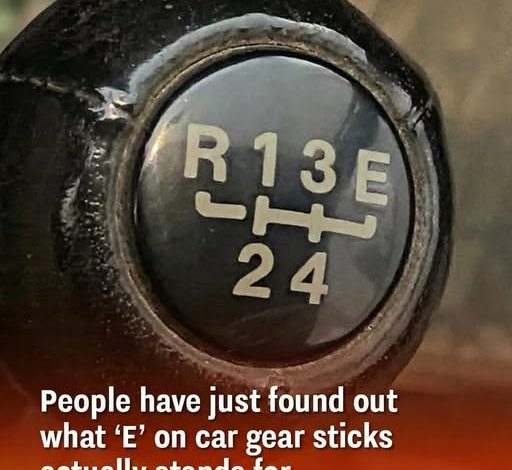
The Mystery of the “E” Gear in Older Cars and What It Really Meant
A Familiar Driving System That Once Defined Generations of Vehicles
For many decades, operating a car followed a predictable and widely understood system. Manual transmissions typically used numbered gears along with a clearly marked “R” for reverse, while automatic vehicles relied on a standardized set of letters such as “P” for park, “N” for neutral, and “D” for drive.
Because these layouts became so common across manufacturers, most drivers rarely questioned the meaning behind the symbols on their gear selectors. The system felt universal, simple, and consistent from one vehicle to another.
However, as automotive design evolved and older vehicles remained in circulation, certain unfamiliar markings began to attract curiosity—especially among younger drivers encountering them for the first time.
Growing Curiosity Around the “E” Gear
One of the most frequently questioned symbols found in some older cars is the letter “E” on the gear stick. For many drivers today, its purpose is not immediately obvious, leading to discussion and speculation about its original function.
This curiosity has grown as enthusiasts and everyday drivers encounter older automatic vehicles that still retain original gear selector markings that differ from modern designs.
The presence of this single letter often raises questions about whether it represents a hidden feature, a special driving mode, or a discontinued automotive setting.
What “E” Stood for in Older Vehicles
In earlier automotive systems, the letter “E” stood for “Economy.” It was designed as a dedicated driving mode focused on improving fuel efficiency during everyday use.
At a time when vehicles lacked advanced computer-controlled engine management systems, manufacturers introduced simpler mechanical and transmission-based adjustments to help drivers reduce fuel consumption.
The “Economy” setting was one of these early solutions, offering a way to optimize performance for efficiency rather than power.
How Economy Mode Changed Vehicle Behavior
When activated, Economy mode altered several aspects of how a vehicle operated. It typically reduced engine revolutions per minute (RPM), adjusted throttle response to be less aggressive, and in some cases modified the timing of automatic gear shifts.
These changes encouraged smoother and more fuel-conscious driving behavior, especially during highway travel or steady-speed conditions.
While acceleration became noticeably slower and the vehicle felt less responsive, many drivers accepted this trade-off as it helped reduce fuel consumption and lower overall driving costs.
A Reflection of Changing Priorities in Automotive Design
The introduction of Economy mode marked an important shift in how car manufacturers approached vehicle performance. During that period, fuel efficiency began to take on greater importance alongside traditional priorities such as speed and engine power.
This change reflected broader economic and environmental concerns, particularly during times when fuel prices were rising and efficiency became a practical necessity for everyday drivers.
Unlike modern vehicles, which rely heavily on automated systems, earlier cars required drivers to take a more active role in selecting how their vehicle performed under different conditions.
The “E” gear symbolized this balance between driver control and emerging efficiency-focused engineering.
The Gradual Disappearance of Economy Gears
As automotive technology advanced, dedicated Economy gears began to fade from new vehicle designs. Modern transmission systems evolved to include intelligent software capable of automatically adjusting performance in real time.
Instead of relying on a manual switch for efficiency, today’s vehicles continuously monitor driving conditions and adjust engine output, shift timing, and fuel usage without driver input.
This technological progression made separate Economy modes less necessary, leading to their gradual removal from most modern gear selectors.
The Modern Meaning of “E” in Automotive Contexts
In today’s automotive world, the letter “E” is more commonly associated with electric vehicles and environmentally conscious transportation.
This modern usage reflects the industry’s ongoing shift toward sustainability, reduced emissions, and alternative energy sources.
As a result, the meaning of “E” has evolved significantly from its original purpose, representing not just economy in fuel consumption but also innovation in electric mobility.
A Small Symbol With a Larger Historical Meaning
Although the Economy gear is now largely a feature of the past, its influence can still be seen in modern driving technology. Many of the principles behind it—such as optimizing fuel use and improving efficiency—remain central to vehicle design today.
The simple “E” once found on older gear sticks serves as a reminder of an earlier stage in automotive development, when efficiency features were manual rather than automated and drivers played a more direct role in managing vehicle performance.
In that sense, it represents an important step in the ongoing evolution of transportation technology and the continuous effort to create smarter, more efficient ways to travel.
