Simple Glass Puzzle Reveals Why Appearances Can Be Deceiving
A Visual Challenge That Has Captured Attention
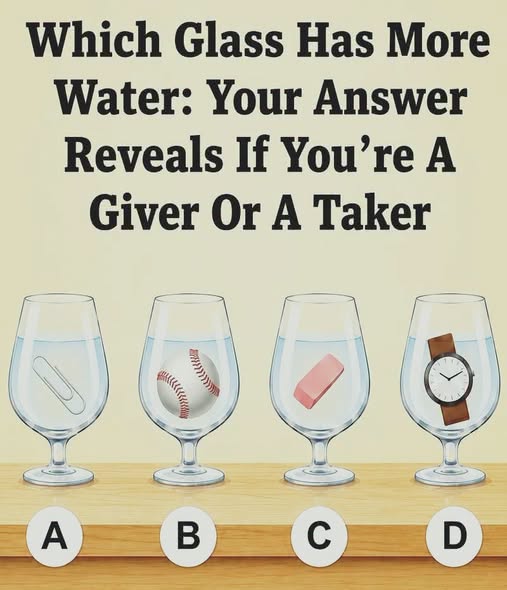
At first glance, the puzzle appears straightforward and easy to solve. Four identical glasses are placed side by side, each filled with water that reaches the same visible level. Inside each glass sits a different object, and the task is to determine which glass contains the greatest amount of water.
Most people instinctively believe the answer will be obvious. Since the glasses are identical in size and the water lines appear perfectly equal, the natural assumption is that all four containers hold the same amount of liquid. This quick judgment is exactly what makes the puzzle so compelling and so effective at challenging perception.
What seems like a simple observation exercise quickly becomes a deeper test of reasoning. The puzzle is not only about what the eye sees, but also about how the mind interprets what is hidden beneath the surface. It exposes how quickly assumptions form and how easily visual information can be misleading when taken at face value.
The popularity of the puzzle comes from this contrast between simplicity and hidden complexity. While the setup appears minimal, the solution requires a shift in thinking that many people do not immediately consider.
The Structure of the Puzzle
The challenge presents four labeled glasses: A, B, C, and D. Each glass contains water that reaches the same height, creating the impression that they all hold equal amounts. However, each glass also contains a different submerged object that changes the actual volume of water inside.
Glass A contains a small paperclip. Glass B contains a baseball. Glass C contains an eraser. Glass D contains a wristwatch. These objects differ significantly in size, and this difference plays a crucial role in solving the puzzle correctly.
At first glance, attention is often drawn only to the water line. Because the surface level appears identical in all four glasses, many assume that no further analysis is necessary. This initial impression is powerful because it aligns with how the human brain prefers to process visual information quickly and efficiently.
However, the objects inside each glass introduce an important factor that is not immediately visible when focusing only on the surface of the water.
Why the Human Mind Is Easily Misled
The puzzle takes advantage of how the brain naturally processes visual information. In everyday life, the mind constantly searches for shortcuts that allow quick judgments without requiring detailed analysis. This mental efficiency is useful in most situations, as it helps people make decisions rapidly.
When faced with four glasses that appear identical in height and structure, the brain quickly categorizes them as equal. This automatic assumption happens before deeper reasoning takes place, leading many people to an immediate but incorrect conclusion.
This type of mental shortcut is common in daily life. It allows individuals to process large amounts of information without becoming overwhelmed. However, it can also lead to errors when important details are hidden or not immediately visible.
In the case of this puzzle, the identical water levels create a strong visual illusion. The eye focuses on the surface alignment while ignoring what is happening inside each container. As a result, the brain prioritizes appearance over underlying physical reality.
The Science Behind the Hidden Difference
The key to understanding the puzzle lies in a basic scientific principle known as displacement. Displacement occurs when an object is placed into a liquid, causing the liquid to move aside to make room for the object. The amount of liquid displaced is directly related to the volume of the object submerged.
This means that larger objects take up more space inside a container, reducing the amount of liquid that can occupy that same space. Even if two containers appear to have identical liquid levels, the actual quantity of liquid inside may be different depending on what is submerged within them.
In this puzzle, each object displaces a different amount of water based on its size. The visible water line remains the same, but the internal volume occupied by each object changes the true amount of liquid in each glass.
This principle reveals why surface observation alone is not enough to solve the challenge. What appears equal on the outside may not be equal when internal volume is considered.
Examining Each Glass in Detail
To determine the correct answer, each glass must be evaluated based on the size of the object inside it and how much space that object occupies within the container.
Glass B contains a baseball, which is the largest object among the four. Because it occupies a significant amount of space inside the glass, it displaces a large volume of water. Although the water level appears identical to the others, the actual amount of water in this glass is reduced the most.
Glass D contains a wristwatch. While smaller than the baseball, it still takes up noticeable space within the glass. This displacement reduces the total amount of water, though not as dramatically as the baseball does.
Glass C contains an eraser. The eraser is smaller than both the baseball and the wristwatch, but it still occupies space that would otherwise be filled with water. This results in a moderate reduction in water volume compared to an empty glass.
Glass A contains a paperclip, which is significantly smaller than all the other objects. Because it occupies very little space inside the glass, it displaces the least amount of water.
As a result, more space remains available for water in Glass A than in any of the other glasses.
The Correct Answer Revealed
The correct answer is Glass A.
Although all four glasses display the same visible water level, the amount of actual water differs due to displacement caused by the objects inside them. The paperclip in Glass A has the smallest volume, meaning it reduces the available water space the least.
In contrast, the larger objects in the other glasses displace progressively more water, reducing the total volume of liquid they contain while still maintaining the same surface level.
This demonstrates that visual equality does not necessarily represent true equality. What appears identical at the surface can conceal important differences underneath.
Appearance Versus Reality
One of the most striking aspects of the puzzle is how clearly it highlights the gap between appearance and reality. People tend to trust what they see because visual information feels immediate and reliable.
However, this puzzle shows that appearances can be misleading when important factors are hidden from direct view. The identical water levels create a strong assumption of equality, even though the internal structure of each glass tells a different story.
The submerged objects act as hidden variables that completely change the outcome. Without considering them, the conclusion will always be incorrect.
This demonstrates the importance of looking beyond surface-level impressions when evaluating any situation that involves hidden or unseen elements.
Why the Puzzle Became Widely Shared
Visual puzzles like this often spread rapidly because they create moments of surprise and realization. Many people respond quickly and confidently, believing the answer is obvious. When they later discover a different explanation, it creates curiosity and encourages discussion.
The simplicity of the setup makes it accessible, while the hidden complexity makes it memorable. People enjoy comparing answers and revisiting their reasoning to understand where their thinking may have gone wrong.
This combination of ease and challenge makes puzzles like this especially engaging. They encourage reflection on how assumptions are formed and how quickly conclusions can be reached without full analysis.
Interpretations of Thinking Styles
Alongside the scientific explanation, the puzzle is often associated with informal interpretations of thinking styles. These descriptions are meant for entertainment and are not based on scientific measurement, but they add an additional layer of interest to the challenge.
Those who choose Glass A are often described as detail-focused thinkers who pay attention to small but important differences. Their approach emphasizes careful observation and logical reasoning before drawing conclusions.
Individuals who select Glass B are sometimes seen as confident decision-makers who rely on overall impressions and instinct. This approach can be effective in many situations but may overlook subtle details.
Those who choose Glass C are often viewed as balanced thinkers who combine intuition with logical analysis. Their reasoning tends to fall between quick judgment and detailed examination.
Meanwhile, people who select Glass D may be characterized as reflective thinkers who consider deeper explanations and look beyond surface appearances before making decisions.
Lessons Beyond the Puzzle
The ideas behind this puzzle extend beyond a simple visual challenge. In everyday life, people frequently make judgments based on first impressions, often relying on what is immediately visible.
However, important factors are not always obvious. Just as the small paperclip changes the outcome of the puzzle, minor details in real situations can have significant effects on results.
This highlights the importance of careful observation and thoughtful analysis. Looking beyond what is immediately apparent can reveal information that changes the entire understanding of a situation.
The puzzle serves as a reminder that quick assumptions, while useful in many cases, are not always sufficient when hidden variables are involved.
A Final Reflection on Critical Thinking
The glass puzzle ultimately encourages a slower and more thoughtful approach to problem-solving. It demonstrates how easily the mind can be influenced by visual cues and how important it is to question initial impressions.
What appears simple at first may contain deeper complexity once all factors are considered. By examining what is not immediately visible, a clearer and more accurate understanding emerges.
In the end, Glass A contains the most water because the paperclip displaces the least volume inside the glass. This small detail becomes the decisive factor that changes the entire outcome.
Beyond the correct answer, the puzzle leaves a lasting message about perception and reasoning. Careful observation and logical thinking often reveal truths that surface appearances alone cannot show.
