Unfamiliar Household Items Spark Curiosity Before Revealing Surprisingly Simple Explanations
An Unexpected Discovery on a Desk
What began as an ordinary afternoon spent waiting in a quiet room turned into an unexpected lesson about how easily everyday objects can become mysteries when they appear outside their usual setting.
While sitting in his girlfriend’s room as she finished getting ready, one man found himself casually looking around the space. Nothing seemed unusual at first. The room contained the typical collection of personal belongings and everyday items that often go unnoticed.
Then a small object sitting on a desk immediately attracted his attention.
Its appearance was unusual enough that he could not identify it at a glance. Unlike common items such as chargers, writing tools, cosmetic products, or household accessories, this object did not fit neatly into any category he recognized.
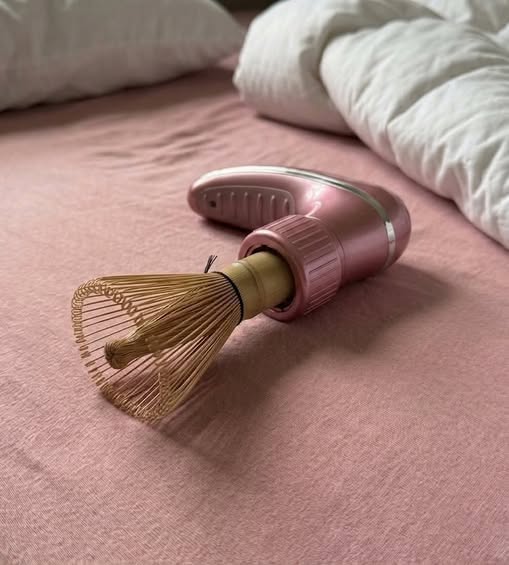
The item featured a sturdy handle that appeared practical and comfortable to hold. Attached to the top was a delicate arrangement of thin wire loops that spread outward in a rounded pattern.
The combination seemed unusual.
The handle suggested durability and purpose, while the wire loops appeared lightweight and fragile. Together, they created a design that was difficult to interpret.
For several moments, he simply stared at it, attempting to connect it to something familiar.
No answer came.
A Growing Sense of Curiosity
Unable to ignore his curiosity, he eventually picked up the object for a closer look.
Turning it over in his hands, he searched for clues that might explain its function. He looked for buttons, switches, screens, hinges, or any obvious mechanical features.
There were none.
The object appeared functional rather than decorative, yet its purpose remained unclear.
The wire loops seemed too delicate for heavy-duty tasks, while the handle appeared designed for active use. Every detail suggested practicality, but none of those details explained exactly what the item was meant to do.
At one point, he considered the possibility that it might simply be decorative. Modern designs often blur the line between art and utility, and the unusual shape could easily fit into either category.
Yet that explanation felt incomplete.
The object seemed designed for a specific task rather than display.
That realization only deepened the mystery.
When Assumptions Begin Filling the Gaps
As the search for an answer continued, imagination naturally stepped in.
Perhaps it belonged in a kitchen. Maybe it was an attachment from a larger appliance. It could have been connected to a hobby, craft, or activity he knew little about.
The possibilities multiplied as he examined it from different angles.
The unfamiliar design encouraged speculation. Without context, every feature seemed open to interpretation.
The wire loops raised questions about stirring, mixing, cleaning, or holding something in place. The handle suggested repeated use. The overall shape looked deliberate but mysterious.
For a brief moment, he considered putting the object back exactly where he had found it and forgetting about it altogether.
That option would have been simple.
However, curiosity had already taken hold.
The item had transformed from an ordinary object into a small puzzle waiting to be solved.
A Surprisingly Ordinary Explanation
After spending time searching for similar items and comparing designs, the answer finally emerged.
The mysterious object turned out to be an electric matcha whisk.
What had appeared confusing at first suddenly became easy to understand.
The tool is designed to help prepare powdered green tea by blending matcha powder with water. The wire loops help break up clumps while creating a smooth consistency and light foam.
The sturdy handle exists to provide a comfortable grip during use.
The delicate wire structure serves the mixing process.
Once the purpose became clear, the unusual design no longer seemed strange.
In fact, every aspect of the object appeared logical and efficient.
The mystery existed only because the item had been found in a setting where it was unexpected.
What looked puzzling on a bedroom desk would have seemed perfectly ordinary in a kitchen.
The realization brought a sense of amusement.
Several minutes of uncertainty had been created by nothing more than unfamiliarity and missing context.
Another Mystery Appears
Only a few days later, a similar situation unfolded in an entirely different location.
This time, the setting was a family home.
While sorting through household belongings, the man’s mother discovered an unusual object hidden inside one of his father’s drawers.
She brought it to the kitchen table, puzzled by its appearance.
The object looked entirely different from the matcha whisk.
Made of metal and featuring several curved sections, it appeared mechanical and purposeful. Certain parts suggested movement or attachment, though its exact function remained unclear.
Neither of them immediately recognized it.
They began examining the object together, passing it back and forth while searching for clues.
Every angle seemed to raise more questions than answers.
The Challenge of Identifying Older Tools
Unlike many modern products, older household tools often provide few visual hints about their purpose.
Contemporary items frequently include labels, screens, buttons, charging ports, or familiar design features that help identify their function immediately.
Older accessories can be far less obvious.
Many were created for specific household routines that have become less common over time.
Without seeing them in use or alongside the equipment they originally accompanied, they can appear confusing and incomplete.
The object found in the drawer created exactly that impression.
Its design clearly served a purpose, but that purpose was no longer immediately recognizable.
The uncertainty encouraged speculation.
At various moments, it seemed possible that the object belonged in a workshop, a kitchen, or even a medical setting.
Each theory appeared reasonable until another detail suggested something different.
The longer they studied it, the more mysterious it seemed.
The object looked carefully manufactured and intentionally designed, making it obvious that it once played a meaningful role.
Yet that role remained hidden.
Finding the Missing Piece of the Story
Eventually, they decided to search for answers.
What they discovered was surprisingly straightforward.
The object was a vintage kitchen accessory associated with a household appliance from an earlier era.
Its purpose involved helping guide or strain liquid during food preparation.
The design that had seemed confusing suddenly became understandable.
The curves, metal construction, and movable sections all served practical functions connected to routine kitchen tasks.
Once its purpose was known, the mystery vanished almost instantly.
The object no longer looked strange or complicated.
Instead, it appeared to be exactly what it was: a useful household accessory from a different period.
Whether it had been kept for sentimental reasons or simply forgotten over time remained unknown.
What mattered was that the answer proved entirely ordinary.
A Common Pattern Emerges
Although the two objects were completely different, both experiences followed the same pattern.
Each item initially seemed mysterious because important context was missing.
In the first case, a modern kitchen tool appeared in an unexpected location.
In the second, an older kitchen accessory had become separated from the appliance and routine that once explained its purpose.
Without context, both items appeared far more complicated than they actually were.
Once their functions became clear, the confusion disappeared.
The objects themselves never changed.
Only the understanding of the people examining them changed.
That shift transformed puzzling discoveries into ordinary household items.
How Familiarity Shapes Understanding
Many objects seem obvious to people who use them regularly.
A matcha enthusiast would likely recognize an electric whisk immediately. Someone familiar with older kitchen equipment might identify a vintage accessory without hesitation.
To people outside those experiences, however, the same objects can appear completely unfamiliar.
Knowledge plays a major role in recognition.
What one person sees as ordinary, another may view as unusual simply because they have never encountered it before.
This difference often explains why certain household discoveries generate confusion.
The issue is rarely the object itself.
The challenge comes from the absence of information needed to interpret it correctly.
Why Context Matters So Much
Human beings naturally seek explanations for unfamiliar things.
When an object fails to fit into an existing category, the mind begins generating possibilities.
This tendency serves an important purpose.
It helps people understand their environment, solve problems, and identify potential risks.
However, it can also encourage unnecessary speculation when information is limited.
A simple kitchen tool may appear unusual when removed from its normal environment.
An appliance component may seem mysterious after decades in a drawer.
An ordinary design can appear strange when separated from the activity it was created to support.
Context provides the missing connection.
It explains not only what an object is but also how, where, and why it is used.
Without that connection, even practical items can become difficult to understand.
The Reality Behind Most Household Mysteries
Despite their intriguing appearances, both discoveries ultimately led to simple explanations.
The first object was an electric whisk used to prepare matcha.
The second was a vintage kitchen accessory designed to guide or strain liquid during food preparation.
Neither item was secretive, alarming, or unusual once its purpose became known.
Both were practical tools created for everyday tasks.
Many homes contain similar mysteries.
Drawers, storage boxes, closets, and cabinets often hold items connected to previous hobbies, outdated appliances, or routines that are no longer part of daily life.
As years pass, the stories behind those objects can fade.
The objects remain, but the context disappears.
When that happens, ordinary possessions can suddenly seem far more mysterious than they truly are.
A Lesson in Looking More Carefully
Both experiences offered the same reminder.
It is easy to assume that an unfamiliar object must have a complicated explanation.
It is equally easy to allow imagination to fill gaps in understanding.
Yet many mysteries disappear once enough information becomes available.
Sometimes an unusual item is simply a tool from a routine someone else knows well.
Sometimes it is a forgotten accessory connected to older technology or household habits.
Sometimes it is a practical design that appears strange only because it has been removed from its intended setting.
Taking time to observe, investigate, and gather context often reveals a far simpler answer.
That process can be surprisingly rewarding.
Beyond solving a mystery, it offers insight into everyday life, changing technology, and the countless tools people use without giving them much thought.
In the end, the most important discovery was not the identity of the objects themselves.
It was the realization that unfamiliarity can make ordinary things appear extraordinary.
Sometimes a mystery object is not mysterious at all.
Sometimes it is simply an everyday item waiting for its missing context to be restored.
