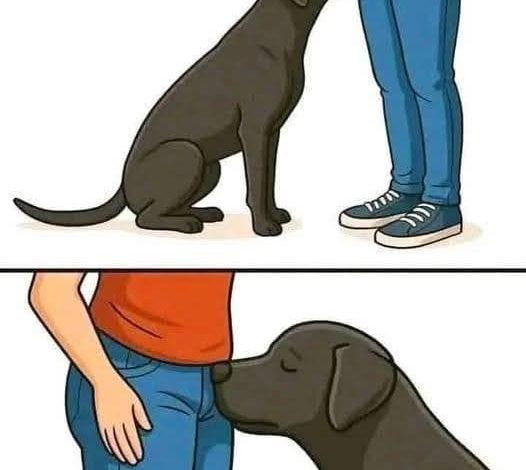
Why Dogs Sniff People’s Genital Area: Understanding a Common Canine Behavior
When an Awkward Moment Has a Simple Explanation
Many dog owners have experienced the uncomfortable moment when a dog suddenly approaches and begins sniffing their genital area. While the behavior may seem embarrassing in social situations, it is actually a normal part of how dogs gather information about the world around them.
Unlike humans, who depend heavily on sight and language, dogs rely primarily on their sense of smell to understand their surroundings. What may appear unusual or inappropriate to people is often a completely natural form of communication for a dog.
When a dog investigates a person in this way, it is not attempting to be rude, invasive, or embarrassing. Instead, it is using its strongest sense to learn more about the individual standing in front of it.
Understanding why dogs engage in this behavior can help owners respond calmly and recognize that it is usually driven by curiosity rather than any form of misbehavior.
The Extraordinary Power of a Dog’s Nose
Dogs experience the world through scent in a way that humans cannot fully appreciate. Their sense of smell is dramatically more sensitive than our own, allowing them to detect odors that people would never notice.
While humans often rely on visual cues and spoken communication to identify others, dogs collect information through scent signatures. Every person carries a unique combination of odors that can reveal a surprising amount of information.
For a dog, a scent is more than a smell. It is a source of detailed information that helps the animal recognize individuals and understand changes occurring around them.
Because of this remarkable ability, dogs frequently use their noses whenever they encounter someone new or when they notice a change in a familiar person’s scent.
What appears to be a brief sniff to a human can provide a dog with a large amount of information in a matter of seconds.
Why Certain Areas Attract More Attention
The human body produces odors from various regions, but some areas naturally generate stronger scent signals than others.
Among the most significant sources of these odors are apocrine glands. These glands produce distinctive body scents that contain chemical information detectable by dogs.
Apocrine glands are especially concentrated in areas such as the armpits and the genital region. As a result, these parts of the body often produce stronger odors than other areas.
For a dog using scent to gather information, these locations are particularly interesting because they provide a concentrated source of chemical signals.
Although humans may not consciously notice these scents, a dog’s highly developed nose can easily detect them.
The stronger the scent, the more information a dog may be able to collect. This is one reason dogs often focus their attention on these regions when meeting someone.
Why Dogs Often Choose the Crotch Area
Many people wonder why dogs seem especially interested in sniffing the crotch area rather than other parts of the body.
The answer is largely practical from the dog’s perspective. While the armpits also contain strong scent-producing glands, they are generally located too high for a dog to access comfortably.
The genital area, on the other hand, is much easier for many dogs to reach.
As a result, dogs often investigate this region because it provides one of the strongest and most accessible scent sources available.
To the dog, this behavior is not unusual. It is simply the most efficient way to gather information about a person.
What may feel socially awkward to humans is viewed by the dog as a routine and effective method of learning about someone new.
A Canine Version of an Introduction
Dogs have their own methods of greeting one another, and scent plays a central role in those interactions.
When two dogs meet, they frequently sniff each other because certain areas of the body release pheromones and other scent-related signals.
These odors help dogs identify one another and gather information that contributes to social interactions.
The behavior is a normal part of canine communication and serves as a way for dogs to become familiar with one another.
When a dog sniffs a person’s genital area, it is often performing a similar type of investigation.
Rather than relying on conversation or visual introductions, the dog uses scent to understand who the person is.
In many cases, the dog is simply attempting to gather information in the same way it would when meeting another animal.
What Information Dogs May Be Detecting
The odors produced by the human body can contain a variety of chemical signals.
Dogs are capable of detecting differences in scent that people cannot perceive.
As a result, a dog may be able to recognize individual identity through smell alone.
Changes in mood, activity levels, and other biological factors can also influence a person’s scent profile.
For a dog, these changes may be noticeable even when they are completely invisible to humans.
This ability explains why dogs often seem fascinated by particular individuals or become interested in someone they have met before.
The animal may simply be noticing details communicated through scent that people are unable to detect.
What seems like a simple sniff may actually be the dog gathering a wide range of information.
Why the Behavior May Become More Noticeable
There are certain situations in which dogs may show a greater interest in sniffing people.
One common example occurs when a dog meets someone for the first time.
New scents naturally attract a dog’s attention because they provide unfamiliar information to investigate.
A dog may spend more time sniffing a stranger than someone it encounters regularly.
Changes in a person’s scent can also trigger increased curiosity.
Physical activity, including exercise, may alter body odor and make certain scents more noticeable to a dog.
Hormonal changes can also affect how a person smells.
Because dogs are highly sensitive to these variations, they may become more interested when they detect something different from what they have encountered before.
In many cases, the behavior reflects curiosity rather than any specific concern.
Social Curiosity Rather Than Bad Manners
People often interpret canine behavior through a human lens, which can lead to misunderstandings.
Actions that seem impolite to people are not necessarily viewed the same way by dogs.
Dogs do not attach the same social meaning to certain parts of the body that humans do.
Instead, they focus on the information available through scent.
When a dog approaches and begins sniffing a person, the behavior is usually driven by a desire to learn more about that individual.
The animal is not attempting to cause embarrassment or invade personal space intentionally.
From the dog’s perspective, it is simply engaging in a natural form of investigation and social interaction.
Recognizing this difference in perception can help owners better understand their pets’ actions.
Managing the Behavior
Although the behavior is normal, not everyone is comfortable with it.
Fortunately, dogs can learn alternative ways to greet people.
Training and redirection are often effective tools for reducing unwanted sniffing behavior.
When a dog begins approaching someone in an overly enthusiastic manner, owners can redirect its attention toward another activity.
Simple commands may also help establish more appropriate greeting habits.
Commands such as “sit” or “stay” encourage the dog to focus on the owner rather than immediately investigating a visitor.
Consistent reinforcement can help the dog understand what behavior is expected.
Rewarding calm greetings may gradually replace habits that people find uncomfortable.
As with many aspects of dog training, patience and consistency are important.
Over time, many dogs can learn to interact with people in ways that are more comfortable for everyone involved.
Balancing Natural Instincts and Social Expectations
Dog owners often face the challenge of balancing natural canine behavior with human social norms.
Sniffing is an important part of how dogs gather information and interact with their environment.
Completely eliminating this instinct is neither realistic nor necessary.
Instead, training focuses on teaching dogs when and how to express natural behaviors appropriately.
This approach allows dogs to remain curious while also respecting the comfort of people around them.
Understanding the motivation behind the behavior can make it easier to respond constructively rather than with frustration.
When owners recognize that the dog is acting out of curiosity rather than disobedience, training often becomes more effective.
Understanding Your Dog’s Perspective
Dogs interpret the world differently from humans. Their primary source of information is not conversation, appearance, or body language alone, but scent.
Every interaction provides an opportunity for a dog to gather details through its powerful nose.
The genital area often attracts attention because it contains strong scent signals that are easy for dogs to access.
To the animal, investigating those scents is simply a way of learning more about a person.
While the behavior may create awkward moments, it is generally a normal expression of canine curiosity and social communication.
With proper guidance and training, dogs can learn alternative greeting behaviors when necessary.
At its core, however, the behavior reflects a dog’s natural desire to understand the people around it.
Rather than attempting to embarrass anyone, the dog is simply using the language it knows best—its remarkable sense of smell.
