Thousands of Blue Sail-Like Creatures Washing Ashore Are Not Plastic Pollution but a Remarkable Ocean Phenomenon
Strange Blue Shapes Appear Along Coastlines After Storms
After powerful coastal storms, beach visitors are sometimes greeted by an unusual sight stretching across the sand.
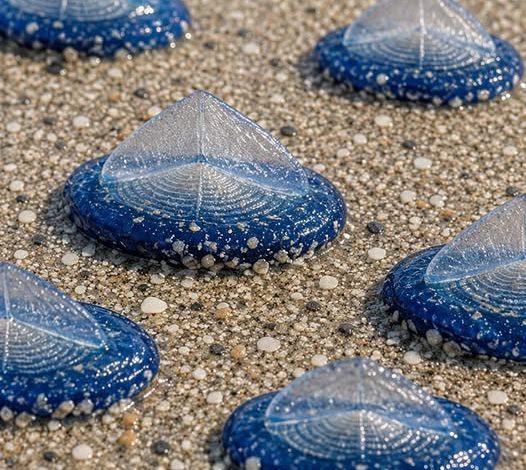
Thousands of translucent blue ovals can appear seemingly overnight, covering large sections of shoreline and creating an image that many people find alarming.
At first glance, the objects often resemble pieces of discarded plastic.
Each one features a vivid blue body topped by a transparent sail-like structure, giving the impression of manufactured debris that has washed in from the sea.
Concerned beachgoers frequently wonder whether they are witnessing an environmental problem.
The appearance of so many identical objects can easily create the impression that a large amount of waste has entered the ocean.
In reality, these unusual formations are not pollution at all.
They are living marine organisms known as Velella velella, commonly referred to as “By-the-Wind Sailors.”
Their arrival on beaches is part of a natural process that combines ocean currents, wind patterns, and biological adaptation.
A Creature Often Mistaken for Plastic
The distinctive appearance of Velella velella is one of the main reasons they attract so much attention.
Their bright blue coloration and transparent upper structure make them stand out sharply against sand and rocks.
When large numbers wash ashore together, they can create a striking blue blanket along the coastline.
Because they look artificial, many people assume they are some form of marine debris.
However, these creatures are entirely natural and have evolved specifically to live at the ocean’s surface.
Their unusual design allows them to travel vast distances while floating on top of the water.
Although they are frequently compared to jellyfish, they are not true jellyfish.
Instead, they belong to a group of marine animals known as hydrozoans.
This places them among the relatives of the Portuguese Man o’ War, another well-known surface-dwelling ocean organism.
A Colony Rather Than a Single Animal
One of the most fascinating aspects of Velella velella is that each individual is not actually a single organism.
What appears to be one creature is instead a colony composed of numerous specialized polyps working together.
These tiny connected organisms perform different functions that contribute to the survival of the entire colony.
By sharing responsibilities, the colony operates as a coordinated unit despite being made up of multiple individual components.
This cooperative structure allows the organism to feed, float, and reproduce effectively while drifting across the ocean surface.
The arrangement represents a highly specialized survival strategy developed over countless generations.
Rather than functioning independently, the individual polyps depend on one another to sustain the colony as a whole.
The Unique Structure of a By-the-Wind Sailor
The most recognizable feature of Velella velella is the clear triangular sail rising above its body.
This rigid crest is made from chitin, a durable material also found in crab shells and insect exoskeletons.
The sail serves a simple but highly effective purpose.
It captures wind and allows the organism to travel across the ocean surface.
Beneath the sail lies a blue oval float.
This flat structure contains gas that keeps the colony buoyant.
By remaining at the very surface of the water, the organism can take full advantage of wind-driven movement.
The combination of float and sail creates an efficient natural vessel capable of crossing large stretches of ocean.
Its design is remarkably simple yet extraordinarily successful.
The vivid blue coloration serves additional purposes beyond visual appeal.
The color helps protect the colony from intense sunlight while also providing camouflage.
Viewed from above, the blue tones can help reduce visibility to predatory birds.
This adaptation improves the organism’s chances of survival in the open ocean.
Masters of Wind-Powered Travel
Unlike many marine creatures, Velella velella cannot actively swim.
Its movement depends almost entirely on environmental conditions.
Wind and ocean currents determine where these colonies travel.
Because they spend their lives floating at the water’s surface, they are uniquely influenced by atmospheric patterns.
This dependence on wind has led to one of the species’ most remarkable evolutionary adaptations.
To avoid being driven consistently toward land, the species developed two different sail configurations.
Some individuals possess what are commonly described as left-handed sails.
Others have right-handed sails.
The orientation of the sail determines the direction in which the organism moves relative to the wind.
This variation helps distribute populations across the ocean rather than concentrating them in a single area.
Left-Handed and Right-Handed Ocean Travelers
The distinction between left-handed and right-handed sails is critical to the species’ survival.
When wind strikes a left-handed sail, the organism tends to move to one side of the wind’s direction.
Those with right-handed sails move toward the opposite side.
This arrangement creates a natural balancing system.
Instead of all individuals being pushed along identical paths, populations spread across broader regions of the ocean.
The adaptation helps maintain the species within open-water environments where it is best suited to live.
Under typical conditions, these floating colonies drift through large ocean circulation systems and remain far from shore.
For much of their existence, they travel silently across the sea, unnoticed by people on land.
However, weather patterns occasionally disrupt this balance.
How Storms Create Massive Strandings
The dramatic beach landings associated with Velella velella usually occur after significant changes in wind direction.
Large storms can alter prevailing coastal winds and create conditions that drive floating colonies toward land.
When this happens, millions of organisms may be carried shoreward over a relatively short period.
The result is a spectacular mass stranding event.
Entire stretches of beach can become covered with blue bodies and transparent sails.
For people encountering the phenomenon for the first time, the scene can be both beautiful and surprising.
The concentration of so many organisms in one place often creates the impression that something unusual or catastrophic has occurred.
In reality, these events are natural consequences of weather and ocean dynamics.
The creatures simply follow the forces acting upon them.
Once strong winds redirect their course, they have little ability to resist being carried toward shore.
Do These Creatures Pose a Threat to Humans?
One of the first questions many beach visitors ask concerns safety.
Because Velella velella are related to the Portuguese Man o’ War, their appearance can trigger concern.
The association leads some people to worry about painful stings.
These concerns are understandable.
Like their relatives, By-the-Wind Sailors possess stinging cells known as nematocysts.
These structures are located beneath the blue floating disc.
Their primary purpose is to capture tiny plankton that serve as food.
For humans, however, the stinging capability is generally much weaker.
In most cases, the stingers are unable to penetrate thick human skin effectively.
This means that simply encountering the organisms on the beach does not usually result in serious injury.
As a result, they are not considered highly dangerous to people.
Why Caution Is Still Recommended
Although the risk is relatively low, some care should still be taken when handling freshly stranded specimens.
The stinging toxins can remain present even after the organisms have washed ashore.
Someone who touches a fresh Velella and then rubs sensitive areas such as the eyes, nose, or mouth may experience irritation.
In these situations, a painful burning sensation can occur.
For that reason, direct contact should be approached cautiously.
Those interested in examining the organisms more closely may choose to wear gloves.
For most people, simply observing them without touching is the safest approach.
Their unusual appearance can be appreciated fully without physical contact.
Maintaining basic caution helps ensure that a fascinating beach discovery remains a positive experience.
What Happens After They Reach Shore?
Once stranded on land, Velella velella face a challenging environment.
Unlike conditions in the ocean, beaches expose them to direct sunlight and drying air.
As a result, they dehydrate quickly.
Over the course of several days, their bright blue coloration fades.
The soft tissues gradually dry out and disappear.
What remains is often a delicate, transparent shell-like structure.
These paper-thin remnants can persist briefly before eventually breaking down.
The transformation is dramatic.
The vibrant organisms that arrived in large numbers become nearly invisible fragments scattered across the sand.
The process marks the final stage of a journey driven entirely by wind and weather.
A Natural Spectacle of Ocean Life
Mass strandings of Velella velella serve as a reminder of the powerful connection between marine life and environmental forces.
The creatures spend much of their existence drifting across the ocean, guided by winds and currents they cannot control.
Their remarkable design allows them to survive in a challenging habitat where mobility depends entirely on natural conditions.
When storms alter those conditions, enormous numbers can suddenly appear on shorelines.
The resulting displays often leave lasting impressions on those who witness them.
What initially appears to be a field of blue plastic is actually evidence of a highly specialized marine species carrying out a life cycle shaped by evolution.
The combination of floating colonies, wind-powered movement, and unique sail structures makes Velella velella one of the ocean’s most distinctive organisms.
For beachgoers fortunate enough to encounter a large stranding event, the experience offers a rare glimpse into the complexity and beauty of life at the sea’s surface.
Rather than pollution, the blue ovals scattered across the sand represent a natural phenomenon that has been occurring for generations, demonstrating the extraordinary ways marine organisms adapt to the forces of nature.
