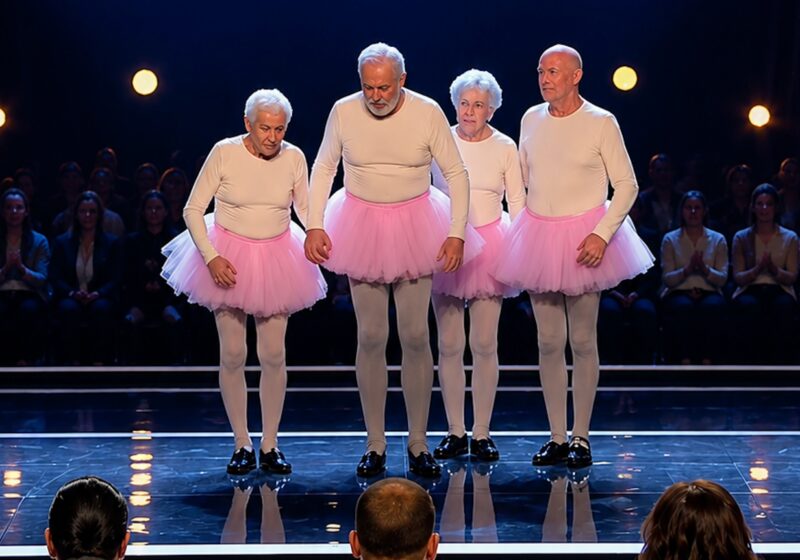
Four Elderly Dancers in Tutus Stun Talent Show Audience with an Unforgettable Performance
A Night of Expectations and Fatigue in the Theater
A large talent show was underway inside a packed concert hall, where performers of many kinds had already taken the stage. Singers, magicians, acrobats, and dancers had each delivered their acts under bright stage lighting, gradually filling the evening with entertainment that was beginning to lose its novelty for the audience.
As the program continued, the energy in the room slowly shifted. Some spectators leaned back in their seats, growing less attentive, while judges casually reviewed their scorecards with increasing indifference. The atmosphere suggested that the most memorable moments of the night had already passed.
Despite this, the host maintained an upbeat tone and introduced each new act with enthusiasm, keeping the flow of the show moving forward toward its next surprise.
An Unexpected Introduction
At one point in the program, the host announced a group of performers that immediately drew curiosity. The introduction described four elderly men who lived in a retirement home and had once been close friends. Life had separated them for many years, but they had recently reunited and spent months preparing a special performance.
The audience responded with polite applause, assuming they were about to witness something simple and nostalgic, perhaps a choir performance or a traditional musical piece. Nothing suggested what was about to happen next would defy every expectation in the room.
As the stage curtains began to open, anticipation filled the theater, though no one could predict the shock that was waiting just beyond them.
The First Reaction from the Audience
Four elderly men stepped slowly onto the stage. Each appeared to be around eighty years old. Their costumes immediately stood out: white leotards, pink ballet tutus, white tights, and black dance shoes.
For a brief moment, the entire hall fell into silence. The unusual contrast between their age and attire created confusion among the audience, as people tried to understand the intention behind their appearance.
That silence did not last long. Soon, laughter began to spread across the theater. What started as a few reactions quickly became widespread amusement, with many spectators pointing toward the stage and reacting with disbelief.
Some audience members made lighthearted remarks, questioning how the performers had arrived in such costumes or whether the act was meant to be humorous rather than serious. Others recorded the moment on their phones, treating it as an unexpected comedic highlight of the night.
Judges React with Skepticism
The panel of judges also struggled to conceal their reactions. Smiles and smirks appeared as they observed the elderly performers standing quietly in their ballet attire.
One judge, known for their television presence, leaned toward the microphone and addressed the group with visible skepticism. The comment highlighted their age and questioned their decision to perform ballet on such a major stage in such an unusual presentation.
Another judge added further criticism, suggesting that a different style of performance might have been more suitable and implying that the act risked becoming a spectacle rather than a serious display of talent.
These remarks intensified the laughter within the audience, reinforcing the perception that the performance was not to be taken seriously. Yet the four men remained composed, standing still under the bright lights without reacting to the commentary or the laughter surrounding them.
A Quiet Confidence Before the Music Begins
Despite the ridicule filling the theater, the performers did not respond with words or gestures. Their silence created a striking contrast to the noise of the crowd. They remained focused, as though waiting for a moment only they understood.
One of the men gently held the hand of another and spoke quietly, asking for patience. His calm reassurance suggested that what the audience was witnessing at that moment was not the true performance, but only its beginning.
Shortly after, the host signaled for the music to start. The stage lights dimmed, and the atmosphere shifted instantly as the laughter began to fade into uncertainty.
The Transformation on Stage
When the music finally began, the tone inside the theater changed completely. An old ballet melody filled the hall, a piece reminiscent of classical performances from decades earlier.
At first, the men barely moved. Then, almost simultaneously, each of them stepped forward with controlled precision. What followed defied the expectations built moments before.
Their movements became smooth, deliberate, and unexpectedly graceful. Instead of the hesitant motions the audience had anticipated, the performers demonstrated balance, timing, and coordination that reflected deep familiarity with classical dance.
As they continued, the choreography grew more complex. Spins, transitions, and lifts were executed in perfect synchronization. The performance carried a level of discipline that contrasted sharply with their appearance, creating a powerful shift in perception across the room.
From Laughter to Silence
The reaction in the audience changed rapidly. Laughter disappeared entirely, replaced by focused attention. Conversations stopped, and many viewers lowered their phones as they realized they were witnessing something unexpected and deeply skillful.
The judges, who had previously shown amusement, now watched in complete silence. Their expressions shifted from doubt to surprise as the performance continued to unfold with increasing intensity.
The men transitioned seamlessly into a more modern style of movement, blending traditional ballet techniques with elements of contemporary choreography. The combination created a dynamic rhythm that seemed impossible for performers of their age, yet it was executed with precision and control.
The Final Moments of the Performance
As the music reached its peak, the choreography intensified. Each movement flowed into the next without hesitation, building toward a conclusion that held the entire theater in suspense.
When the final notes played, the performers completed their routine and came to a still position. For several seconds, the hall remained completely silent. The absence of sound felt heavier than the earlier laughter, as the audience processed what they had just witnessed.
Then, almost suddenly, the entire theater rose to its feet. Applause erupted with overwhelming force, filling the space with a reaction that contrasted sharply with the earlier mockery. The standing ovation continued as the performers remained on stage, visibly composed but deeply emotional.
The Story Behind the Performance
One of the judges eventually stepped forward and asked the question that many in the room were thinking. The performers were invited to explain who they were and how they had achieved such a remarkable display.
The oldest of the four men spoke on behalf of the group. He explained that more than fifty years earlier, they had been dancers in a small ballet theater. They had once shared the same dream of performing on a grand stage, but their path was interrupted when the theater closed.
Life had taken them in different directions after that moment. One became a factory worker, another worked as a bus driver, one spent his life as a mechanic, and another became a schoolteacher. Over the decades, they stopped dancing entirely and drifted apart.
Years later, a medical diagnosis given to one of them changed everything. Faced with limited time, they reunited after more than half a century apart. That reunion reignited their shared dream, leading them to prepare a performance that would bring their past back to life one final time.
Aftermath and Public Reaction
The performance quickly spread beyond the theater. Recordings of the act circulated widely, reaching audiences far beyond those who had been present that night. Viewers around the world watched the transformation from ridicule to admiration, responding with strong emotional reactions.
Many were moved not only by the technical skill displayed on stage, but also by the story behind it. The combination of lifelong friendship, lost opportunity, and final fulfillment of a shared dream gave the performance a deeper meaning that extended beyond entertainment.
The four men, once laughed at and dismissed by the audience, became symbols of perseverance and dedication. Their journey demonstrated that talent does not disappear with age and that long-forgotten dreams can still find a final moment of expression.
A Final Reflection
What began as an act of mockery on a brightly lit stage transformed into a powerful reminder of human resilience. The audience entered the evening expecting amusement, but left with a memory that challenged their assumptions about age, ability, and purpose.
The four elderly dancers proved that passion can endure across decades and that the desire to create does not fade simply because time passes. In the end, their performance was not about competition or recognition, but about completing a story that had been paused for more than half a century.
The theater that once echoed with laughter became a place of silence, respect, and admiration, marking the conclusion of a performance that no one present was likely to forget.
