A Quiet Holiday Suite and the Hidden Intruder That Changed Everything
Arrival and the Illusion of Perfect Escape
Dawn had only just begun to lift itself over the horizon when we first stepped into the suite, bringing with it a warm glow that seemed to promise the start of something entirely removed from ordinary life. The air outside carried the softness of a coastal morning, thick with humidity and the faint salt of the nearby sea. Inside, everything felt deliberately arranged to reinforce the sense that this was meant to be an escape from all routine pressures and obligations.
We had spent months preparing for this moment, setting aside money with careful discipline and choosing a boutique-style resort that was meant to offer both comfort and privacy. The intention behind every decision had been simple: to create a space where time would slow down, where nothing urgent could reach us, and where the world beyond the shoreline would feel distant and irrelevant.
The suite itself seemed to fulfill that promise without effort. Soft white linens were neatly arranged across a large king-sized bed, and polished wooden furnishings reflected the natural light in a calm, understated way. Floor-to-ceiling windows opened the room to a wide view of the ocean, where the water stretched out in shifting tones of turquoise and deep blue. Everything appeared carefully maintained, as if designed to encourage relaxation without interruption.
For the first two days, that illusion held firmly in place. We moved through the space in a relaxed rhythm, alternating between quiet moments indoors and long walks along the coastline. Meals felt unhurried, conversations felt lighter, and even silence seemed more comfortable than usual. It was easy to believe that nothing could disturb the atmosphere that had formed around us.
The First Sign of Something Unseen
The discovery did not arrive in the form of alarm or panic. There was no sudden noise, no disruption that immediately demanded attention. Instead, it began during a quiet afternoon that felt no different from any other moment spent inside the suite.
One of us was sitting on the edge of the bed, casually looking through photographs taken earlier that day. The room was bright, filled with natural light that softened the edges of the furniture and made everything feel still and undisturbed. It was in that calm setting that the eye was drawn upward, toward the meeting point where the painted wall met the crown molding near the ceiling.
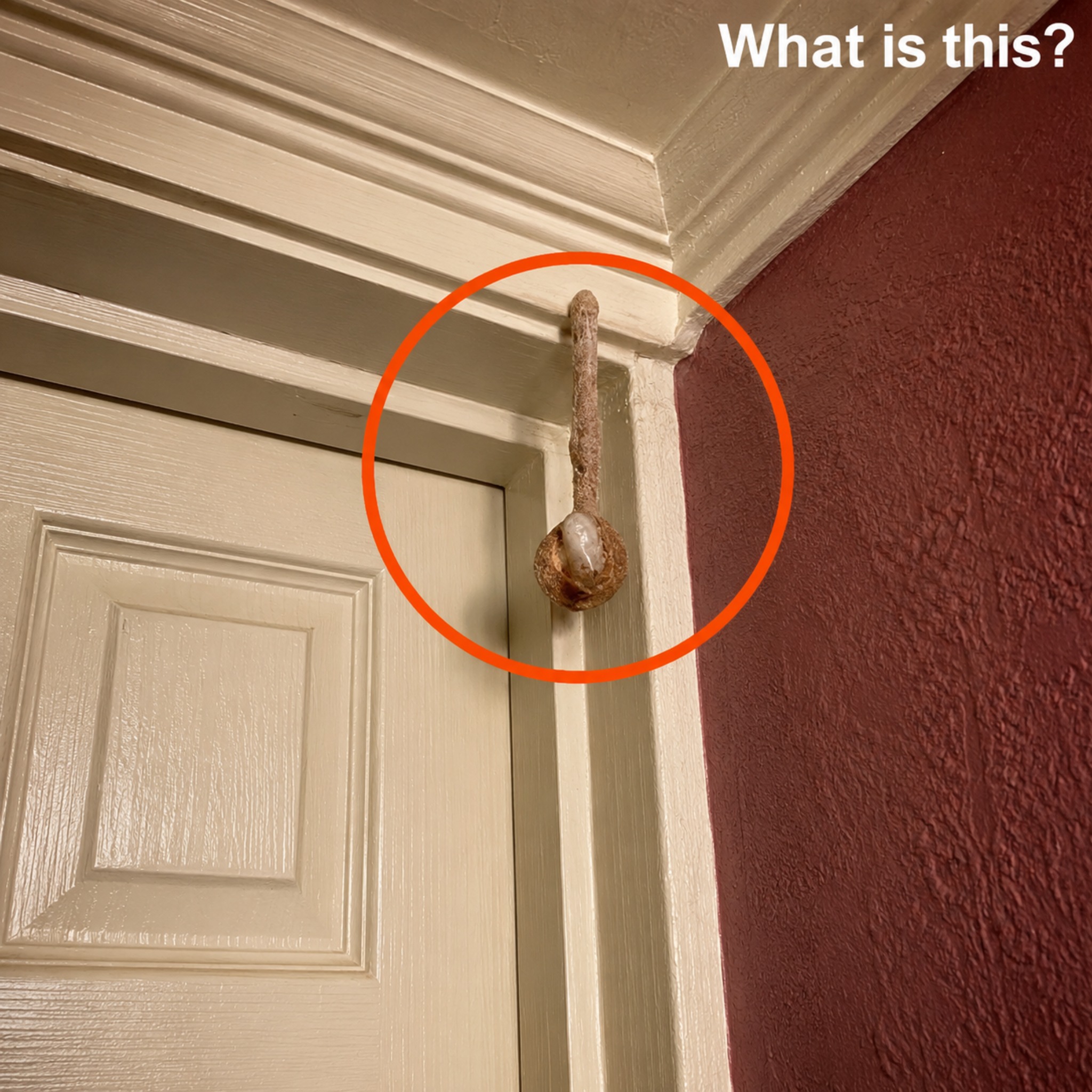
At first, what appeared there seemed insignificant. It looked like a small irregular cylinder, something dried and earthy, attached to the otherwise smooth surface. It did not immediately register as something unusual. In fact, it resembled a minor flaw, perhaps a remnant from construction or an unnoticed imperfection in an otherwise polished room.
But attention, once directed toward it, does not easily move away. The longer it was observed, the more it resisted simple explanation.
Recognition and Growing Unease
Curiosity slowly replaced casual observation. Another person in the room stepped closer, narrowing their focus on the object near the ceiling. The initial assumption of harmless debris began to weaken as the structure became clearer. It was not random or accidental. It had form, repetition, and intention behind its shape.
What had seemed like a small piece of dried material revealed itself as something deliberately constructed. Layered earth formed a compact tubular shape that clung firmly to the wall. The more it was studied, the more it suggested design rather than coincidence.
With that realization came a shift in tone. What had been a quiet moment of curiosity began to carry a subtle weight of discomfort. The structure was no longer just an object; it was evidence of something living, something that had taken residence in a space assumed to be entirely controlled and clean.
As the focus sharpened further, the truth became harder to ignore. The formation was a mud nest created by a wasp, carefully built over time from layers of hardened soil. Its structure suggested repetition and effort, each layer placed with purpose until a sealed chamber had formed.
The realization introduced an unsettling thought. If such a structure existed here, unnoticed for an unknown period, then the assumption of complete isolation within the suite no longer felt reliable.
The Hidden Life Inside the Structure
The discomfort deepened as imagination filled in what could not be seen. The sealed earthen chamber was not empty. Within it, life was unfolding in complete silence, hidden just beyond sight.
The idea that a living insect was developing inside the structure created a sharp emotional reaction. The mind struggled to reconcile the beauty of the surrounding space with the hidden reality embedded in its surface. What had been perceived as a flawless environment now contained something entirely separate, functioning independently within its boundaries.
Even more unsettling was the understanding of what the structure represented. It was not random shelter, but a carefully constructed environment intended to support growth and survival. Small prey had been collected and stored within it, forming a sealed system of sustenance. The concept alone was enough to transform curiosity into discomfort.
The suite, once viewed as a protected and isolated retreat, suddenly felt more porous. The boundaries between human comfort and the natural world no longer seemed solid. Instead, they felt thin and negotiable, capable of being crossed without warning.
Emotional Shift Within the Suite
After the realization set in, the atmosphere inside the room changed noticeably. The space that had once felt calming now carried a quiet tension. Ordinary objects such as lamps, curtains, and furniture began to draw more attention than before, as if reassessment had become unavoidable.
Every corner of the suite seemed newly unfamiliar. What had once been interpreted as elegance now felt fragile, as though it had been constructed over something unseen and unpredictable. The sense of complete comfort began to erode under the weight of awareness.
There was a brief internal struggle over whether the reaction was justified. The structure itself was contained, and there was no immediate threat. Yet the emotional response did not align with logic alone. Awareness alone was enough to shift perception.
Eventually, the discomfort reached a point where ignoring it was no longer possible. A decision formed to inform the front desk, even if the situation seemed minor on a practical level. The feeling of unease had become significant enough to override hesitation.
Contacting Assistance and Waiting
The call to the front desk was made with careful wording, attempting to maintain composure while explaining the situation. On the other end of the line, there was a pause that suggested both processing and mild surprise, followed by a professional acknowledgment of the request.
The response time was brief. Within a short period, a maintenance staff member arrived at the suite. The individual carried a calm, practical demeanor, one shaped by familiarity with a wide range of unexpected requests and situations.
After being shown the area near the ceiling, the staff member observed the structure without visible alarm. There was a quiet inspection, a moment of assessment, and an understanding that this was a matter requiring simple removal rather than escalation.
Careful Removal and Return to Stillness
Using a small tool, the maintenance worker carefully approached the structure and detached it from the wall. The process was controlled and deliberate, designed to avoid damage to the surrounding surface or disruption to the room.
The removal itself was uneventful. There was no dramatic reaction, no sudden movement, and no unfolding disturbance. The structure came away cleanly, leaving behind only a faint mark on the wall where it had once been attached.
It was placed into a container, handled with the same neutrality as any other minor maintenance task, and removed from the suite. The worker offered a brief, courteous acknowledgment before leaving, restoring the room to its previous stillness.
With the structure gone, the suite once again appeared unchanged at first glance. The furniture remained polished, the light continued to shift gently through the windows, and the ocean outside maintained its steady presence.
Aftermath and Lasting Impression
Even after the physical presence had been removed, its impact remained. The memory of what had been discovered lingered in thought, refusing to dissolve entirely into the background of the holiday experience.
The small mark left on the wall became a subtle reminder that the space had contained something unnoticed for an unknown period of time. It represented a moment where perception shifted suddenly, revealing how easily assumptions of separation from nature can be disrupted.
What stayed most strongly was not fear, but awareness. The realization that even in carefully designed environments, life continues in quiet, hidden forms just beyond immediate perception. The idea that the natural world does not pause or exclude itself simply because a space is refined or controlled became impossible to ignore.
As the holiday continued, the experience did not overshadow every moment, but it remained present in the background of thought. The ocean view, the comfort of the suite, and the calm surroundings were still appreciated, but with a slightly different understanding than before.
There was a lingering recognition that even the most carefully maintained spaces exist within a larger, ongoing system of life. What had once been seen as complete separation now felt more like temporary overlap. And in that realization, the experience gained a deeper, more grounded meaning that stayed long after the moment itself had passed.
