
The Corgi Everyone Thought Was Dangerous Was Protecting a Life-Changing Secret
A Critical Deadline Inside the Shelter
A bright red label on the shelter intake form marked a grim decision that seemed final.
EUTHANIZE. 9:00 AM.
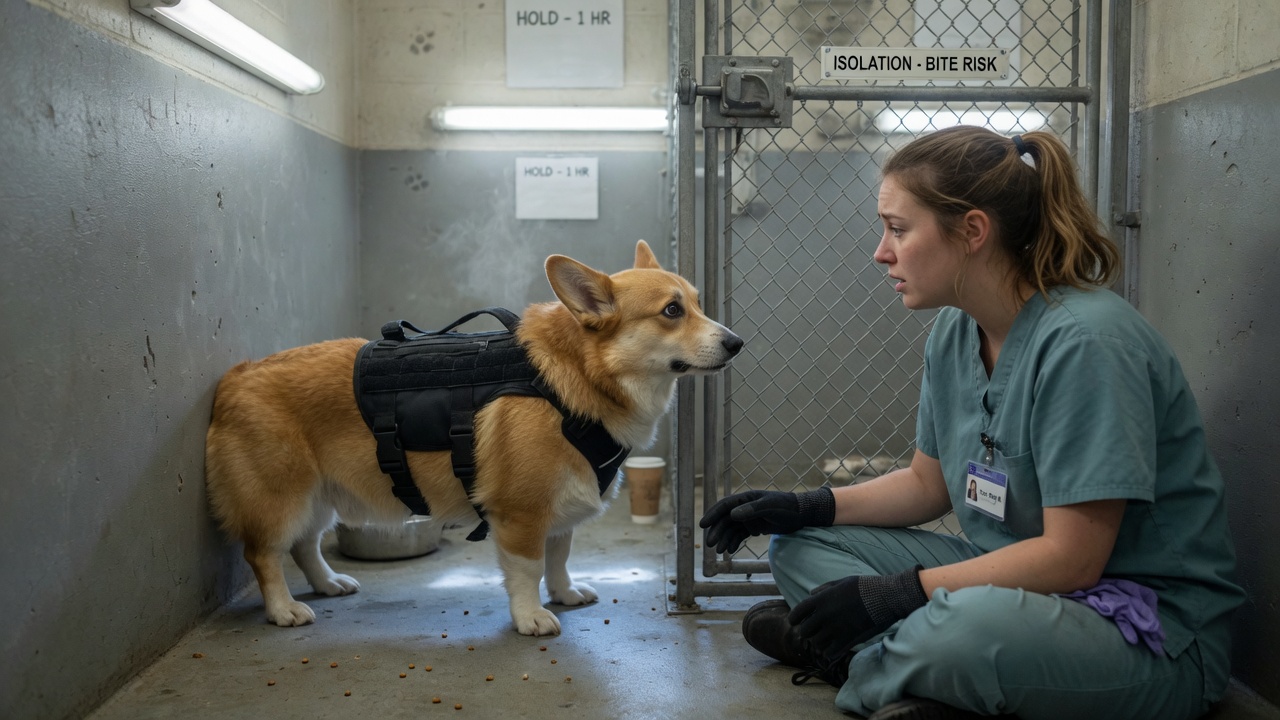
With less than an hour remaining, a Corgi identified only as Tag #842 sat alone in an isolation area of the facility. Staff members had labeled him highly aggressive after multiple incidents in which he snapped at employees and resisted handling. Over time, concern had escalated into certainty, and many believed the dog could not safely be rehabilitated.
Among the staff, opinions were divided, but the majority leaned toward one conclusion: the animal posed too great a risk to remain alive within the shelter system.
However, veterinary technician Sarah remained uncertain. Despite the warnings, she felt the dog’s actions were rooted in fear rather than hostility. Each reaction appeared defensive, as though he was protecting something or reacting to unseen stress.
An Unusual Harness Draws Attention
When Sarah entered the isolation room, her attention immediately shifted to the oversized tactical harness strapped tightly around the Corgi’s body. The equipment appeared significantly too large for a dog of his size and showed signs of wear, dirt, and damage.
Rather than behaving like an aggressive animal, the Corgi remained pressed against the wall, guarding the front of his body and refusing to expose the harness. His behavior suggested distress rather than intent to attack.
At first, Sarah considered the possibility of an underlying medical condition, such as a hidden injury or painful growth beneath the straps. That possibility was serious enough to justify a closer examination before any final decision could be carried out.
A Careful Approach Leads to a Discovery
Despite the dog’s fear and tension, Sarah slowly moved closer. The Corgi growled softly but did not lunge or attempt to bite. His reaction remained defensive, not aggressive, as if warning her away rather than preparing to attack.
After several cautious minutes, she reached the harness and began examining it in detail. One of the utility pouches caught her attention due to a noticeable bulge inside it. At first, it appeared to be the source of discomfort or injury.
However, as she carefully assessed the pouch, she noticed subtle movement. The realization changed everything. The contents were not a wound or foreign object, but something alive.
The Hidden Life Inside the Harness
With trembling hands, Sarah opened the pouch and removed its contents. Inside was a newborn kitten, extremely small and fragile. Its eyes remained closed, its body cold, and its condition clearly critical.
The discovery immediately explained the dog’s behavior. The Corgi had not been acting aggressively toward staff members. Instead, he had been protecting the vulnerable kitten hidden inside the harness at all costs.
Every defensive reaction, every growl, and every moment of resistance was connected to his effort to keep the tiny animal safe in a hostile and unfamiliar environment.
A Shift From Fear to Understanding
Once the kitten was carefully lifted from the harness, the Corgi’s demeanor changed noticeably. The tension that had defined his earlier behavior began to fade, replaced by calm attentiveness.
He gently nudged the kitten and closely followed every movement, showing clear concern and protective instinct. The transformation made it evident that the shelter staff had misinterpreted his earlier actions.
What had once been labeled as aggression was now understood as determined guardianship under extreme stress and injury.
A Second Emergency Emerges
While attention shifted to the newborn kitten, another critical issue became apparent. Once the harness was fully removed, signs of severe injury were revealed beneath it.
The Corgi had been suffering from a significant chest wound. The tightly fitted harness had unintentionally acted as a form of compression, slowing what could have been severe blood loss.
Shortly after the harness was removed, the dog’s condition deteriorated rapidly, and he collapsed. Emergency medical intervention was initiated immediately as staff worked to stabilize him.
The Identity Hidden Within the Harness
During a detailed examination of the harness, staff discovered an identification card concealed within one of its compartments. The card belonged to Captain James Sterling.
The discovery created immediate confusion and urgency among the shelter personnel. The name was recognized by the shelter director, who identified Captain Sterling as her missing son.
He had been reported missing following a severe flooding incident and a vehicle accident days earlier, and search efforts had not been successful in locating him.
Reconstructing the Events
Authorities and staff pieced together the likely sequence of events. The Corgi, later identified as Barnaby, had survived the same incident as Captain Sterling. Despite suffering a serious chest injury, the dog continued moving through dangerous conditions.
At some point, Barnaby encountered the newborn kitten and placed it inside the harness to protect it from cold and danger. Alongside this, he carried the identification card belonging to his owner, which later became a crucial clue in the search efforts.
Through these actions, Barnaby unintentionally provided the information needed to redirect rescue operations toward the missing individual’s location.
A Rescue Effort Reaches Its Goal
Using the details recovered from the harness, rescue teams were able to adjust their search strategy. The new information significantly narrowed the area of focus, ultimately leading to the successful location of Captain Sterling.
He was found alive, though injured, and in need of immediate assistance. The discovery marked a turning point in what had previously been a desperate and uncertain search operation.
Meanwhile, both the kitten and Barnaby received medical care. The kitten stabilized under treatment, while Barnaby underwent emergency procedures to address his chest injury.
A Reunion After Survival
Following surgery and recovery, Barnaby was reunited with Captain Sterling. The moment brought an emotional response from those present, as the bond between the dog and his owner became immediately evident.
Barnaby responded with excitement and relief, showing clear recognition and affection. After days of uncertainty and critical conditions, the reunion marked a powerful moment of resolution.
The shelter environment, once associated with fear and impending euthanasia, became the setting for a profound reversal of fate.
A Changed Perspective
In the aftermath of the incident, shelter staff reassessed their initial judgment of Barnaby. What had once been interpreted as dangerous aggression was redefined as protective behavior under extreme circumstances.
The dog’s actions had contributed to multiple life-saving outcomes, including the survival of a newborn kitten and the eventual location of a missing individual.
His case became a lasting reminder that behavior driven by fear, pain, or protection can often be misunderstood when viewed without full context.
Barnaby’s story ultimately reshaped how those involved viewed animal behavior, reinforcing the importance of careful evaluation before making irreversible decisions.

