
Police K-9’s Refusal at Officer’s Funeral Leads to a Critical Discovery
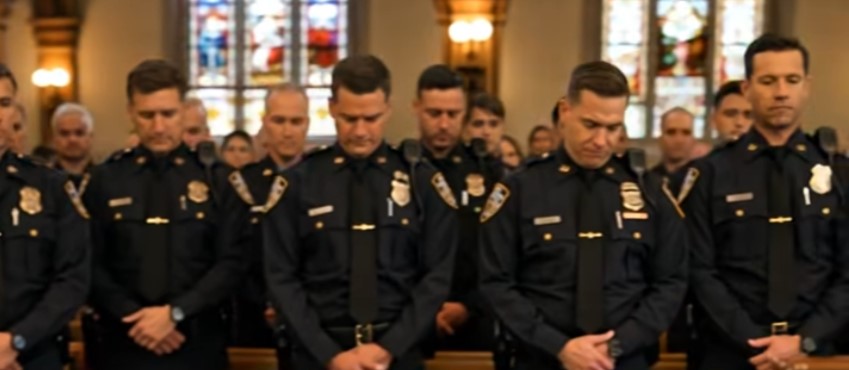
The morning of Officer Michael Grant’s funeral was quiet and overcast, with a steady rain falling over St. Bartholomew’s Memorial Hall. Rows of officers in formal uniforms filled the space, standing in respectful silence as they gathered to honor a colleague known for his steady character and years of service.
At the front of the hall stood an open coffin, where Grant, a 41-year-old officer, had been carefully prepared according to tradition. His uniform was neatly arranged, his badge rested over his chest, and his hands were placed in a formal position. The setting reflected both respect and loss, as friends, family members, and fellow officers paid their final respects.
What drew the attention of nearly everyone present, however, was not only the ceremony itself but the presence of Titan, Grant’s German Shepherd K-9 partner. The dog had climbed into the coffin and refused to leave. His head rested across Grant’s chest, and one paw lay gently over the badge.
At first, many assumed this was a natural display of loyalty and grief. Police dogs often form strong bonds with their handlers, and it was not unusual for them to show signs of distress in such moments. The atmosphere in the room reflected this understanding, as no one wanted to disturb what appeared to be a quiet expression of attachment.
As the service continued, however, Titan’s behavior began to draw closer attention. His posture remained tense rather than relaxed, and his eyes stayed open and focused. Instead of appearing confused or withdrawn, he seemed alert, as though he was responding to something specific in his environment.
Lieutenant Daniel Brooks, who had worked alongside Grant for years, noticed the difference. What initially seemed like grief began to feel unusual. Sergeant Cole Ramirez, head of the K-9 unit, also observed Titan closely. With experience handling trained police dogs, he recognized that the behavior did not match typical signs of distress.
Titan’s position appeared deliberate. His body was steady, and the placement of his paw over Grant’s chest seemed purposeful. Rather than simply staying close, the dog appeared to be guarding something.
The atmosphere in the room shifted subtly as this realization took hold. What had been a moment of mourning now carried a sense of uncertainty.
That feeling intensified when Titan suddenly lifted his head and focused his attention across the room. His posture stiffened, and a low growl broke the silence. The sound immediately drew attention, causing conversations to stop.
Titan’s focus was directed at another officer present at the service, Jason Mercer. Mercer stood among his colleagues in uniform, but under the dog’s gaze, his composure appeared less certain. Titan did not look away. Instead, he adjusted his position, remaining firmly over Grant’s body.
Attempts to calm the situation were made, with some suggesting that the dog was reacting emotionally. However, Ramirez understood that trained K-9s do not respond randomly in such a controlled manner. Titan’s reaction suggested recognition and intent.
At that point, the mood of the funeral shifted further. What had begun as a solemn ceremony now carried an undercurrent of concern.
Detective Luis Alvarez, who had been reviewing details related to Grant’s final case, entered the hall during this moment. When he observed Titan’s posture and focus, he immediately recognized that something required attention.
Rather than focusing only on the dog, Alvarez examined the area Titan continued to cover. Upon closer inspection, he noticed a slight irregularity beneath the lining of Grant’s uniform. It was subtle but noticeable enough to raise questions.
Alvarez asked those nearby to step back, creating space around the coffin. Titan did not resist when the detective approached. Instead, the dog shifted slightly, allowing access while remaining close.
Carefully, Alvarez opened part of the uniform lining and discovered a small object hidden inside. It was a flash drive.
The discovery changed the tone of the entire room. What had been a moment of reflection became a situation requiring immediate attention.
The object was secured and taken to a controlled setting, where proper procedures were followed. Officers present understood that the contents could be important and needed to be handled carefully.
When the drive was examined, it contained several files, including an audio recording and supporting documents. The recording featured Grant’s voice, explaining that he had been investigating irregularities connected to department operations.
He described concerns about internal misconduct and indicated that he had gathered information to support his findings. He also explained that he had chosen to hide the material in his uniform as a precaution, believing it would remain undiscovered unless someone looked closely.
The recording referenced Mercer directly, suggesting a connection that required further investigation. Grant also noted that Titan had reacted to certain individuals during the course of his work, something he believed was significant.
This information provided context for the dog’s behavior during the funeral. What had initially been interpreted as grief now appeared to be a trained response to a situation the dog recognized.
Following this discovery, procedures were initiated to investigate the claims. Mercer’s behavior became more unsettled as the situation developed, drawing further attention from those present.
As events unfolded, Mercer attempted to leave the area but was quickly stopped by officers. Titan, responding to the situation, moved decisively and helped prevent further escalation. The dog’s training ensured that the response remained controlled, allowing officers to secure the situation safely.
Once the immediate situation was under control, the focus returned to the significance of what had been uncovered. The evidence found on the drive led to a broader investigation, which examined operational procedures and internal conduct.
Over time, this investigation revealed issues that required formal action. The findings were handled through appropriate legal and administrative channels, ensuring that due process was followed.
For those who knew Grant, the discovery provided a deeper understanding of the circumstances surrounding his work. It also highlighted the level of care he had taken in preserving information he believed to be important.
Titan’s role in the situation became widely recognized. His behavior at the funeral was no longer seen solely as an emotional response, but as a continuation of his training and partnership with his handler.
After the service and the initial stages of the investigation, arrangements were made for Titan’s future. Grant’s family chose to take responsibility for the dog, providing a familiar and supportive environment.
The transition allowed Titan to remain connected to those who had been part of Grant’s life. Over time, he adjusted to a quieter routine, while still maintaining the discipline and awareness developed through his training.
Visits to Grant’s resting place became part of that routine. In those moments, Titan’s behavior reflected a calmer presence, no longer marked by tension but by a steady sense of connection.
The events surrounding the funeral left a lasting impression on everyone involved. What began as a moment of loss evolved into a situation that revealed important information and led to meaningful action.
Grant’s efforts ensured that his work would not go unnoticed, while Titan’s response demonstrated the depth of the bond between a K-9 and its handler. Together, they contributed to an outcome that extended beyond the original circumstances.
This story serves as a reminder of the role that dedication, preparation, and partnership can play in complex situations. It also highlights how careful attention to unusual details can lead to important discoveries.
In the end, what seemed like a moment of quiet grief became something more significant. It reflected not only loss, but also responsibility, awareness, and the continuation of a commitment to truth and accountability.

