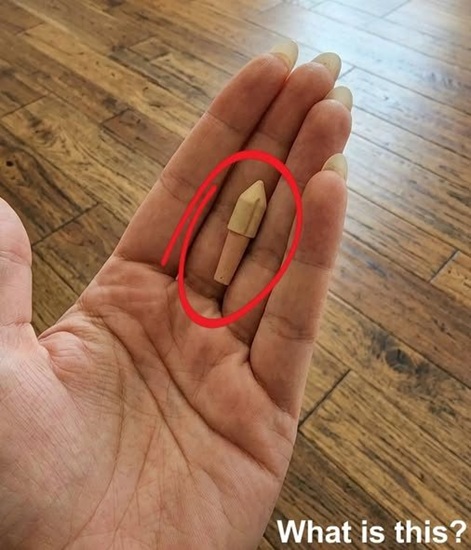
What I Found in My Husband’s Pocket While Doing Laundry
The Discovery in the Laundry Room
It began as an ordinary moment, the kind that rarely leaves any memory behind. I was preparing to wash my husband’s clothes, sorting through pockets out of habit so nothing important would be ruined in the machine. Everything felt routine until my fingers met something unexpected hidden deep inside the lining of his jeans.
The object felt cold and solid, with a shape that immediately stood out from the soft fabric around it. It was jagged in a way that made me pause before I even fully pulled it out. The weight of it in my hand seemed disproportionate to its size, and that alone created an instant sense of unease that I could not ignore.
I stood there in the laundry room without moving, the sound of the house fading into the background as my attention locked onto what I was holding. The overhead light cast a dull glow, just enough to show the outline of something carefully shaped rather than randomly formed. My mind struggled to assign it any familiar identity, and the lack of recognition only made the moment feel heavier.
Rising Uncertainty and Immediate Assumptions
In those first few seconds, my thoughts rushed ahead of logic. I turned the object slowly in my palm, examining every edge and contour as if it might suddenly reveal its purpose. The surface showed signs of use, faint scratches catching the light at certain angles, suggesting it was not something decorative or accidental. It looked intentionally designed, which only deepened my uncertainty.
The shape did not resemble anything I would normally expect to find in clothing. It felt deliberate, almost engineered, as though it belonged to a specific function I was not aware of. That gap in understanding created a mental space that quickly filled with possibilities, none of them calming or neutral.
I tried to ground myself by thinking of ordinary explanations, but nothing matched what I was seeing. The more I examined it, the more my imagination attempted to construct meaning where none was immediately available. My breathing changed without me noticing at first, becoming shallower as my thoughts began to accelerate.
In that state of uncertainty, even small details felt significant. Every angle seemed to suggest intent, every mark appeared like a clue, and every unfamiliar feature pushed my mind further into speculation. I was no longer simply holding an object; I was trying to interpret something I believed might carry hidden significance.
Confronting My Husband
Eventually, I left the laundry room and found my husband, still holding the object as if it might disappear if I set it down. I expected some reaction that matched the intensity building inside me. I expected at least confusion, concern, or curiosity about why something so unusual had been in his pocket.
Instead, his response was calm, almost indifferent. He barely looked at it, as though it carried no importance at all. That reaction unsettled me even more than the discovery itself, because it created a disconnect between what I was feeling and what he seemed to perceive.
When I asked about it, he shrugged and said he did not know what it was or how it had ended up in his pocket. There was no urgency in his voice, no attempt to examine it closely, no sign that it held any meaning for him. That calmness, rather than easing my concern, intensified it, because it made the situation feel uneven and unresolved.
I stood there trying to reconcile his reaction with my own growing sense of alarm. The contrast between his indifference and my anxiety made the moment feel even more confusing, as if we were experiencing two completely different realities based on the same object.
Hours of Overthinking and Emotional Escalation
After that conversation, I returned to the laundry room and sat down without really deciding to. The house had fallen into a quiet rhythm, but the silence around me felt heavier than usual, almost pressuring in its stillness. I kept the object in my hand, turning it over repeatedly while trying to force my thoughts into something more rational.
For nearly an hour, I remained in that position, caught between analysis and emotion. I studied every angle again and again, hoping that repeated observation would eventually lead to clarity. Instead, the lack of clear answers only encouraged my mind to create more interpretations.
As time passed, my thoughts drifted further from logic. I began considering possibilities I would normally dismiss immediately. The object started to feel symbolic rather than simple, as though it represented something hidden rather than something accidental. I found myself thinking about secrecy, about private habits, and about how much of a person’s life can exist outside shared awareness.
The more I reflected on it, the more it felt like a piece of a larger story I had not been told. I started replaying recent days in my mind, searching for moments that might connect to what I had found. Nothing concrete appeared, but that did not stop my thoughts from trying to build patterns out of uncertainty.
At one point, my imagination pushed even further, suggesting scenarios that felt increasingly dramatic the longer I considered them. I became aware that I was no longer evaluating facts but reacting to fear of the unknown. Even so, it was difficult to stop the progression of thoughts once they had fully taken shape.
The Moment of Clarity
Eventually, something in me shifted. I realized that continuing to look at the object in the same way was only reinforcing my own assumptions. I decided to examine it again, but this time with more patience and less emotional weight attached to it.
I moved closer to the window where natural light was stronger. The difference in illumination changed how the object appeared, revealing details that had not been visible before. I rotated it slowly, focusing less on what I feared it might represent and more on what was physically present.
That is when I noticed faint markings near its base. They were subtle and easy to miss, only becoming visible when the light hit at a precise angle. Once I saw them, they immediately shifted my understanding of what I was holding. The tension I had been carrying began to loosen as recognition replaced uncertainty.
The structure, the balance, and the markings all pointed toward a purpose I had not considered earlier. My earlier assumptions began to collapse under the weight of this new understanding. What had felt threatening or secretive was rapidly transforming into something far more ordinary than I had allowed myself to imagine.
The Realization and Emotional Release
With closer inspection, everything finally aligned into a clear explanation. The object was not connected to anything dangerous or hidden. It was a field point used for archery practice, designed specifically for target training. Its shape and construction were intended for precision and sport, not secrecy or harm.
The realization brought an immediate emotional shift. The heaviness I had associated with the object faded, replaced by a kind of quiet embarrassment for how far my thoughts had gone without grounding. What had once felt alarming now seemed almost insignificant in my hand.
I sat back, still holding it, but with a completely different perspective. The same object that had triggered so much anxiety now appeared simple and harmless. The fear that had grown so quickly felt fragile in hindsight, built entirely from misunderstanding and lack of context.
I thought about how easily the mind can construct narratives when information is incomplete. In the absence of clarity, assumptions can grow rapidly, turning neutral details into something far more dramatic than they truly are. The experience made that process feel very real and immediate.
Understanding My Husband’s Perspective
Later, it became clear that my husband had not been hiding anything from me. He had recently taken up a quiet hobby involving archery, something he had not considered necessary to explain in detail. The object had likely ended up in his pocket without any intentional significance attached to it.
There was no hidden meaning behind it, no secret behavior, and no separate life that I had been unaware of. It was simply an item related to a personal interest that had not yet been fully shared or discussed. The absence of communication, rather than any actual concealment, had created the space for misunderstanding.
This realization reframed the entire experience. What had felt like a moment of suspicion turned into an example of how easily assumptions can form when context is missing. The object itself never changed, but my interpretation of it shifted completely once the truth became clear.
What the Experience Left Behind
In the end, the most lasting part of the experience was not the object itself but the emotional journey it triggered. It demonstrated how quickly uncertainty can escalate when the mind tries to fill in gaps without sufficient information. Fear can develop rapidly in silence, even around something completely harmless.
What stayed with me afterward was the realization of how fragile understanding can be when communication is limited. A simple object had become the center of an internal narrative that grew far beyond its actual meaning. Once clarity returned, that narrative dissolved just as quickly as it had formed.
The experience ultimately served as a reminder of how perception can shift based on context. Without explanation, even ordinary things can appear significant or alarming. With understanding, they return to what they were all along—simple, unremarkable, and entirely ordinary.
