

High School Athlete Draws Attention After Podium Stance at California Track Meet Amid Ongoing Sports Eligibility Debate
Podium Moment at CIF Southern Section Finals
A recent California high school track and field competition has drawn widespread attention after a moment at the CIF Southern Section Finals involving Crean Lutheran athlete Reese Hogan.
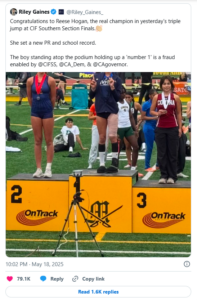
During the event held on May 18, Hogan finished second in the girls’ triple jump. However, after the official awards ceremony concluded, she stepped back onto the podium and positioned herself on the top platform, which had been left unoccupied after the event’s winner had already departed.
The moment quickly circulated online after video footage showed the athlete standing on the first-place spot despite the official results listing her in second place.
The competition included Jurupa Valley High School athlete AB Hernandez, a transgender competitor who was born male and now competes in female categories. Hernandez secured first place in the triple jump with a distance of 41 feet, 4 inches, finishing ahead of Hogan by a significant margin in that event.
Hernandez also competed in multiple disciplines during the meet, including the long jump and high jump. In addition to winning the triple jump, Hernandez placed first in the long jump and finished seventh in the high jump, earning qualification for the CIF Masters Meet scheduled for May 24.
Competition Results and Performance Details
The triple jump results placed Hernandez in first position with a recorded mark of 41 feet, 4 inches. Hogan secured second place following her performance in the same event.
The difference between the two athletes in the triple jump became a central point of discussion following the meet, particularly as Hernandez’s performance also extended across multiple events.
In addition to the triple jump result, Hernandez’s participation in the long jump resulted in another first-place finish. The athlete’s overall performance across events contributed to qualification for the next stage of competition.
The high jump event saw Hernandez finishing in seventh place, rounding out a multi-event performance during the track meet weekend.
Following the competition, the podium moment involving Hogan became widely shared across social platforms, drawing commentary from a range of perspectives and prompting broader discussion about eligibility rules and competition structure in high school athletics.
Online Reactions and Public Commentary
The footage of the podium moment prompted strong reactions online, with discussions quickly spreading across social media platforms.
Some users framed the discussion around competitive fairness and athletic categories. One post stated:
“This guy won the girls long jump and triple jump in a CA track meet over the weekend,”
Another comment highlighted the margin in the triple jump event, stating:
“He won the triple jump by 8ft. He’s really crushing it!”
Other responses focused on disagreement with Hernandez’s participation in the girls’ category, with one user writing:
“Wow, what an accomplishment. I’m sure it had nothing to do with being a biological male,”
Additional reactions emphasized support for Hogan’s podium stance after the results were finalized. One user wrote:
“Second place is the real champion!”
Another added:
“Good on her! This nonsense has to stop,”
Some online comments used stronger language to express frustration with the situation. One post stated:
“The weakest men compete with girls, the weakest minds celebrate it.”
Another user commented on broader social implications, writing:
“I’m sick of this. All the fight for women’s rights is now gone by the same people who fought for women’s rights in the first place.”
Broader Debate Over Athletic Eligibility
The incident has become part of a wider national discussion about the participation of transgender athletes in school and competitive sports categories.
Supporters of inclusion argue that sports should remain open to all participants based on identity and established eligibility rules. Critics argue that current structures raise concerns about fairness in female athletic divisions.
The debate has expanded beyond school competitions and into broader cultural and political discussions, with sports organizations and governing bodies facing ongoing pressure from different sides of the issue.
Political and Policy Positions
The topic has also reached the political level. In February, former President Donald Trump signed an executive order addressing participation rules in women’s sports categories.
The order included a statement declaring:
“The war on women’s sports is over,”
It also referenced upcoming international sporting events, stating that during the Los Angeles Olympic Games, “my administration will not stand by and watch men beat and batter female athletes.”
The policy position contributed to continued national disagreement over how eligibility rules should be structured and enforced across different states and athletic organizations.
Not all states have adopted similar approaches. In Maine, officials have declined to implement restrictions on transgender participation in women’s sports categories, maintaining their own existing participation framework.
Previous Incidents and Ongoing Concerns
The discussion surrounding transgender athletes in school sports has been shaped in part by previous high-profile incidents.
One widely referenced case occurred in North Carolina in 2022 involving a high school volleyball match. During that event, athlete Payton McNabb suffered a serious injury after being struck by a ball during play. The incident led to significant public attention and policy discussions within the state.
Following the event, McNabb’s mother spoke about concerns at the time, stating:
“At the time, we weren’t allowed to speak up. We couldn’t say, ‘No, she’s not playing against a boy, it’s dangerous.’”
That case later influenced legislative action in North Carolina, resulting in a ban on transgender athletes competing on girls’ and women’s teams at multiple educational levels.
National Response and Advocacy Positions
The broader debate has also attracted responses from athletes and advocacy groups at the national level.
More than 400 current and former Olympic athletes signed a letter urging the NCAA not to adopt similar restrictions on transgender participation. The letter emphasized a commitment to inclusivity and expressed a desire to align with evolving standards in sports governance.
Supporters of inclusion argue that sports should remain accessible regardless of gender identity, while others continue to raise concerns about competitive balance in female categories.
One viewpoint expressed online summarized the position of critics, stating:
“The mere fact that men compete against women is absurd,”
Another comment added:
“Trans people should have their own league, and regular, normal people can have their traditional men’s and women’s sports.”

Supporters of Transgender Inclusion in Sports
Not all reactions to the recent track meet were critical. Some commenters defended the participation of transgender athletes within established competition rules.
One user stated:
“She followed all the rules,”
The same comment continued:
“If people don’t like it, the problem is with the rules, not with her.”
Another message of support simply stated:
“Trans girls are girls”
And another commenter added:
“Hernandez won fair and square.”
Response From Athlete AB Hernandez
In a recent interview with Capital & Main, a nonprofit outlet focused on economic, environmental, and social issues in California, Hernandez addressed the attention and criticism surrounding performances during the track and field season.
The athlete described the experience of facing public backlash while continuing to compete in multiple events throughout the season.
In a statement reflecting frustration with criticism, Hernandez said:
“I’m still a child, you’re an adult, and for you to act like a child shows how you are as a person. All I thought was, ‘I don’t think you understand that this puts your idiotic claims to trash. She can’t be beat because she’s biologically male.’ Now you have no proof that I can’t be beat.”
The comments came during a season marked by both strong performances and events where Hernandez did not place among the top finishers, reflecting a range of outcomes across different competitions.
The outlet also noted that studies in the broader discussion surrounding transgender athletes have not consistently shown performance advantages over cisgender competitors, with some findings indicating varied results depending on context and metrics used.
Ongoing National Conversation
The incident at the CIF Southern Section Finals has added another layer to a broader and continuing debate over athletic participation rules in school sports.
With differing policies across states, ongoing legal and political discussions, and strong opinions expressed by athletes, parents, and commentators, the issue remains unresolved at a national level.
The podium moment involving Reese Hogan has become part of that larger conversation, reflecting the intensity of disagreement surrounding fairness, inclusion, and the structure of competitive categories in youth athletics.
As the sport season continues, similar discussions are expected to remain central to public debate as governing bodies and communities navigate competing perspectives on the future of women’s and girls’ sports.

