
Families File Lawsuits After Fatal Tesla Cybertruck Crash Claims Three Young Lives
Deadly Thanksgiving Break Crash Shocks California Community
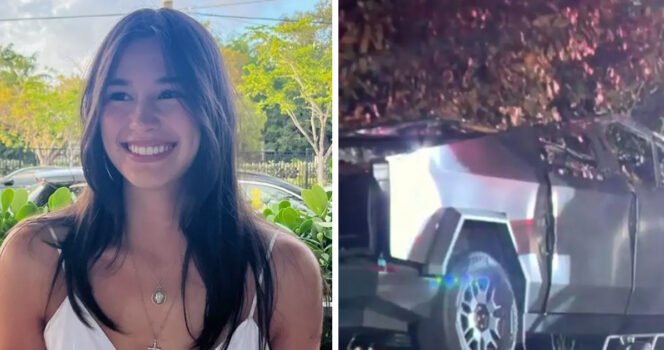
A tragic crash involving a Tesla Cybertruck has sparked national attention after three young people lost their lives during Thanksgiving break in California. The incident, which occurred on November 27, 2024, involved four recent high school graduates traveling together when the vehicle slammed into a retaining wall before bursting into flames.
Among the victims was 19-year-old Krysta Tsukahara, a student attending the Savannah College of Art and Design. Also killed in the crash were 19-year-old driver Soren Dixon and 20-year-old passenger Jack Nelson. All three had recently graduated from Piedmont High School and had returned home for the holiday.
The crash happened in Piedmont, California, where emergency responders arrived to find the Cybertruck completely engulfed in flames.
“Officers arrived on the scene to find a single vehicle fully engulfed in flames. Tragically, this collision resulted in multiple fatalities,” the Piedmont Police Department stated in a public message following the incident.
Only One Passenger Escaped the Burning Vehicle
The only survivor of the crash, Jordan Miller, was rescued moments before the fire consumed the vehicle.
A friend traveling behind the Cybertruck reportedly witnessed the collision and rushed to help. According to reports, the rescuer repeatedly struck one of the windows with a tree branch until it finally cracked after numerous attempts.
The witness then managed to pull Miller, who was described as “barely conscious,” from the vehicle shortly before flames spread throughout the cabin.
The remaining passengers were unable to escape as the fire intensified.
Investigation Revealed Alcohol and Drug Use
Investigators later determined that speed and impaired driving contributed to the deadly collision.
Reports indicated that driver Soren Dixon had methamphetamine and cocaine in his system at the time of the crash. His blood alcohol concentration was reportedly measured at 0.195, more than twice the legal driving limit.
Autopsy findings also showed that both Krysta Tsukahara and Jack Nelson tested positive for alcohol and cocaine.
Despite these findings, the victims’ families argue that the vehicle’s design played a major role in preventing passengers from escaping the fire.
Family Claims Vehicle Became a “Deathtrap”
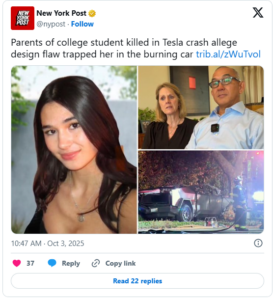
According to a wrongful death lawsuit filed by Krysta Tsukahara’s parents, their daughter survived the initial impact and attempted to escape the vehicle before being trapped inside by a system failure.
The lawsuit alleges that the Cybertruck’s electrical systems malfunctioned after the collision, preventing the doors from opening during the emergency.
“She attempted to get out of the subject vehicle through efforts of a person who was attempting to extract her through the front passenger window due to the failure of the electrical system of the Tesla Cybertruck. She was unable to open her door due to this electrical failure, as was the Good Samaritan who was attempting to rescue her,” the lawsuit states.
The filing further claims that Tsukahara was ultimately forced back by intense heat and flames before dying from smoke inhalation and severe burns.
Her family described the circumstances surrounding her death as devastating and preventable.
Lawsuits Target Tesla and Vehicle Owner’s Estate
Both the Tsukahara and Nelson families have now filed lawsuits against Tesla as well as the estate of the Cybertruck’s owner, Charles Patterson, who was reportedly related to driver Soren Dixon.
The lawsuits accuse Tesla of knowingly selling vehicles with dangerous electronic door systems that can fail during serious crashes.
According to the filings, the Cybertruck’s doors relied on a 12-volt battery-powered system that allegedly became inoperable after the impact.
While Tesla vehicles include manual emergency door releases, the lawsuits claim those mechanisms are difficult to locate and nearly impossible to use during chaotic emergency situations involving smoke, darkness, or fire.
The families argue that passengers trapped inside the burning vehicle were effectively left without a realistic means of escape.
Attorney Says Vehicle Design Failed Victims
Attorney Roger Dreyer, representing the Tsukahara family, strongly criticized the vehicle’s emergency escape design.
“It’s just a horror story. Tesla knows that it’s happened and that it’s going to happen, and they are doing nothing but selling the car with a system that entraps people and doesn’t provide a way of extraction,” Dreyer stated.
He further argued that the design of the Cybertruck directly contributed to Tsukahara’s death.
“The design of this vehicle failed Krysta. There was no functioning, accessible manual override or emergency release for her to escape. Her death was preventable.”
The lawsuits seek punitive damages, claiming Tesla acted with “conscious disregard” for consumer safety.
Parents Speak About Their Daughter’s Death
Krysta Tsukahara’s father, Carl Tsukahara, shared an emotional statement regarding the loss of his daughter.
“Krysta was a bright, kind, and accomplished young woman with her whole life ahead of her.”
He also questioned how a company of Tesla’s size and influence could release a vehicle that allegedly failed in such a critical moment.
“We’ve had to endure not only the loss of our daughter, but the silence surrounding how this happened and why she couldn’t get out. This company is worth a trillion dollars – how can you release a machine that’s not safe in so many ways?”
The statement reflected the growing frustration from families seeking answers about the crash and the vehicle’s safety systems.
Questions Raised About Emergency Door Systems
The lawsuits have renewed public discussion about electronic door systems in modern vehicles, particularly in high-tech electric cars.
Traditional mechanical handles have increasingly been replaced with electronic systems designed to improve aerodynamics and appearance. Critics argue that these systems can become dangerous if power failures occur during collisions or fires.
According to the families’ legal filings, rear passengers in the Cybertruck had access only to concealed manual releases that were difficult to locate under extreme conditions.
The lawsuit filed by Jack Nelson’s parents stated: “Rear passengers like Jack were left with only a concealed mechanical release that was obscure, nonintuitive and highly unlikely to be located or operated in the smoke and chaos of a post-crash fire.”
These allegations have intensified scrutiny surrounding Tesla’s emergency safety designs.
Tesla Cybertruck Faces Ongoing Controversy
The Tesla Cybertruck launched in late 2023 following years of anticipation and significant media attention. Its unconventional design and futuristic appearance quickly made it one of the most discussed vehicles in the automotive industry.
However, the model has also faced increasing criticism and controversy since its release.
In less than two years on the market, the Cybertruck has reportedly experienced multiple recalls and growing public debate regarding safety concerns and reliability.
The fatal California crash has added further pressure as investigations and lawsuits continue to unfold.
The incident has also reignited broader conversations about the balance between advanced vehicle technology and practical emergency safety.
Families Say Responsibility Extends Beyond Driver Behavior
Although investigators concluded that speeding and impaired driving played major roles in the crash, the victims’ families insist that those factors do not excuse alleged design failures.
Attorney Roger Dreyer stated that Tesla should still be held accountable regardless of the driver’s condition.
“They [Tesla] will want to blame Mr. Dixon, anybody but themselves. But this vehicle absolutely should not have entombed these individuals and my clients’ daughter. It’s our way of holding the wrongdoer accountable and correcting bad conduct,” he said.
The legal battle is expected to focus heavily on whether the vehicle’s electronic systems and emergency release mechanisms functioned properly after the collision.
Community Continues Mourning Young Victims
The deaths of Tsukahara, Dixon, and Nelson deeply affected the Piedmont community, where all three were known as recent graduates with promising futures ahead of them.
Friends, classmates, and local residents expressed shock following the tragedy, especially given the young age of the victims and the violent nature of the crash.
For the families involved, the lawsuits represent both an attempt to seek accountability and a broader effort to prevent similar tragedies in the future.
As legal proceedings move forward, the case is likely to draw continued national attention due to its connection to vehicle safety technology, emergency escape systems, and the growing scrutiny surrounding electric vehicle design.
The crash has become more than a local tragedy. It now stands at the center of a wider debate over whether modern automotive innovation is moving faster than critical safety protections designed to save lives during emergencies.

