
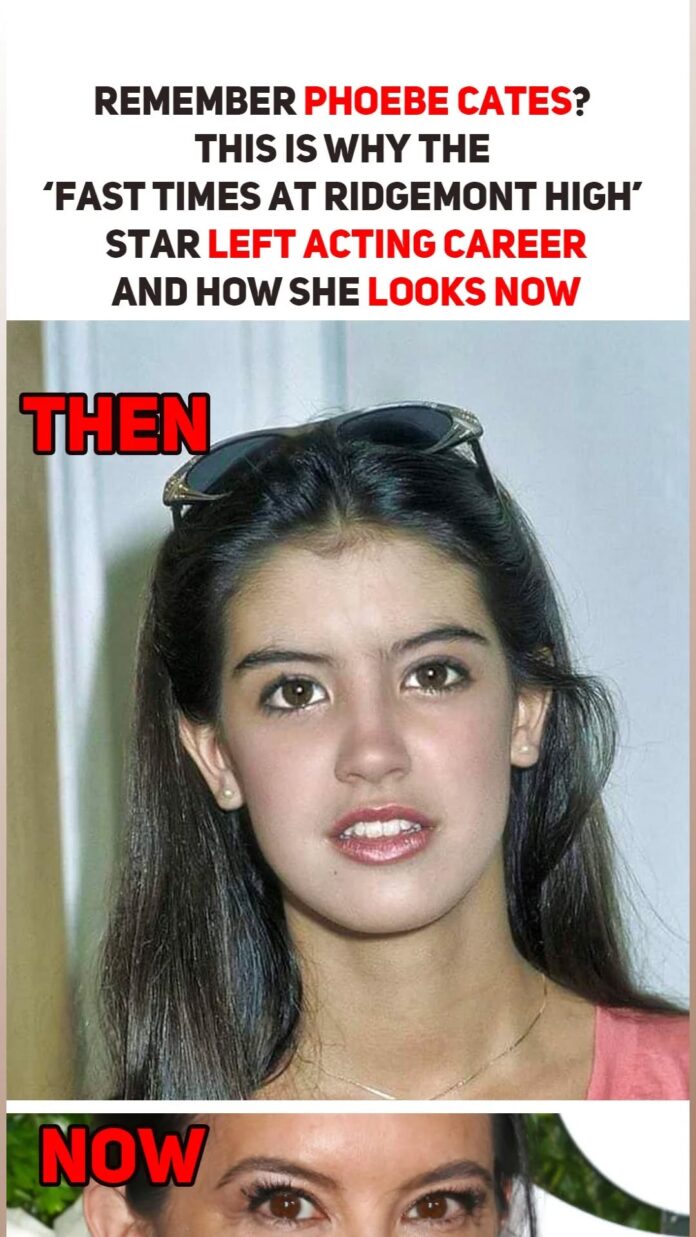
Phoebe Cates Chose Family and Creativity Over Hollywood Fame
A Star Who Defined an Era
During the height of Hollywood’s popularity in the 1980s, Phoebe Cates emerged as one of the most admired actresses of her generation. With a natural screen presence, understated elegance, and memorable performances, she quickly became a recognizable figure in film and popular culture.
Her success was built not only on appearance or celebrity status, but also on a sense of sincerity that audiences connected with immediately. While many stars of the decade pursued constant visibility and expanding fame, Cates eventually chose a far different direction.
Rather than remaining permanently in the spotlight, she built a quieter life centered around family, creativity, and personal fulfillment.
Raised in a Creative Environment
Phoebe Cates was born on July 16, 1963, in New York City, growing up in a family closely connected to the entertainment industry.
Her father, Joseph Cates, worked as a television producer, while other members of her extended family also held important positions within entertainment and production.
The environment surrounding her childhood exposed her to creativity, storytelling, and performance from an early age.
Her cultural background reflected a diverse blend of influences, including Chinese-Filipino, Russian-Jewish, and American heritage. This rich family history contributed to the unique identity and presence that later distinguished her in Hollywood.
Even as a child, she demonstrated artistic instincts that hinted at a future connected to performance and creative expression.
Early Dreams of Becoming a Dancer
Before acting entered her life, Phoebe Cates focused intensely on ballet.
She dedicated years to dance training, investing long hours into practice with dreams of pursuing a professional career as a ballerina.
Her commitment to ballet shaped much of her early adolescence and gave her a strong sense of discipline and artistic focus.
However, those ambitions were unexpectedly interrupted when a serious knee injury forced her to abandon her plans for dance.
The injury marked a major turning point in her life, requiring her to rethink both her future and her identity at a young age.
What initially seemed like a devastating setback eventually opened the door to an entirely different career path.
Transition Into Modeling and Acting
Following the end of her ballet aspirations, Cates entered the world of modeling while still a teenager.
Her striking appearance and natural confidence quickly attracted attention, helping her establish herself within the fashion industry.
Modeling eventually became a bridge into acting, where she soon discovered a new form of artistic expression.
Her transition into film occurred at a time when Hollywood was rapidly embracing young stars who could connect with audiences in a relatable and authentic way.
Cates immediately stood out because she brought warmth and sincerity to her performances rather than relying solely on glamour.
Breakthrough Success in Hollywood
In 1982, Phoebe Cates experienced her major breakthrough with a starring role in Fast Times at Ridgemont High.
The film became one of the defining teen movies of its era, and her performance helped establish her as one of the decade’s rising stars.
Audiences responded strongly to her natural charisma and ability to balance confidence with emotional honesty.
After that success, she continued building her career with roles in films including Private School in 1983 and Gremlins in 1984.
Her performances demonstrated versatility and a strong screen presence that separated her from many of her contemporaries.
When Gremlins became a major success, Cates gained even wider international recognition.
She later reprised her role in Gremlins 2: The New Batch in 1990, further strengthening her connection to one of the decade’s most memorable film franchises.
A Different Kind of Hollywood Star
While many actors pursued nonstop publicity and larger celebrity status, Phoebe Cates developed a reputation for maintaining a more grounded and private personality.
Her appeal extended beyond fashion or appearance because audiences often viewed her as relatable and genuine.
There was a quiet emotional depth in her performances that helped her stand apart within a highly competitive industry.
At a time when Hollywood frequently rewarded constant exposure and aggressive self-promotion, Cates seemed more interested in meaningful work and personal balance.
That difference became even more evident as her career progressed.
Choosing Family Over Fame
One of the most defining moments in Phoebe Cates’ life came not from a film role, but from a personal decision that surprised many within Hollywood.
In 1989, she married actor Kevin Kline, beginning a partnership that would eventually shape the direction of her future.
Together, they made a deliberate decision to prioritize family life over constant professional ambition.
When their children, Owen and Greta, were born, Cates gradually stepped away from acting in order to focus on raising them.
At a time when her popularity remained strong and opportunities continued arriving, the decision reflected a clear commitment to her personal values.
Rather than viewing motherhood as a sacrifice, she described it as a meaningful and fulfilling redefinition of success.
Her choice became increasingly admired over time because it reflected independence and confidence in defining happiness on her own terms.
A Brief Return to Acting
Although Phoebe Cates largely withdrew from Hollywood, she did make occasional creative appearances over the years.
In 2001, she returned to the screen in The Anniversary Party, a project directed by Jennifer Jason Leigh and Alan Cumming.
The film also included appearances by her husband and children, making the project feel especially personal.
Later, in 2015, she contributed voice work for the video game LEGO Dimensions.
These limited returns demonstrated that while she stepped away from the demands of Hollywood fame, she never completely abandoned her connection to storytelling and performance.
A New Creative Passion
As her priorities shifted away from film, Phoebe Cates found a new outlet for creativity through entrepreneurship and design.
In 2005, she opened Blue Tree, a boutique located on Madison Avenue in New York City.
The store reflected her personal style and artistic sensibilities, offering a carefully selected mix of fashion items, books, music, gifts, and home décor.
Rather than operating as a traditional retail shop, Blue Tree became known for its eclectic and highly personal atmosphere.
Visitors often described the boutique as an experience rather than simply a place to shop.
The space reflected Cates’ appreciation for individuality, creativity, and meaningful design choices.
Through the boutique, she found a way to remain creatively engaged without returning fully to the entertainment industry.
A Quiet Life in New York
Today, Phoebe Cates lives a much more private and grounded life compared to the height of her Hollywood fame.
She continues managing her boutique while maintaining close ties to family and creative communities in New York.
Unlike many former stars who remain heavily involved in celebrity culture, Cates has largely avoided constant public exposure.
Her ability to maintain privacy over the decades has become one of the most notable aspects of her life after Hollywood.
Despite stepping away from film, admiration for her work and legacy remains strong among audiences who remember her performances from the 1980s.
Children Continuing the Creative Legacy
Phoebe Cates and Kevin Kline’s children have also pursued artistic careers of their own.
Owen Kline established himself as a filmmaker, earning recognition for his creative work and storytelling abilities.
Meanwhile, Greta Kline became widely known within the indie music world under the professional name Frankie Cosmos.
Both children have developed distinct artistic identities while continuing the family’s longstanding connection to creativity and performance.
Their success reflects the creative environment that surrounded them growing up, shaped by parents who valued expression and individuality over celebrity culture.
Redefining Success
Phoebe Cates’ life story stands out because it challenges traditional ideas about fame and achievement within Hollywood.
Many actors spend decades pursuing greater visibility and larger careers, often at the expense of privacy and personal balance.
Cates instead chose a quieter path centered around fulfillment, family, and authenticity.
Her story is not one of disappearing from public life, but of intentionally redefining what success meant to her.
By stepping away from constant fame at the height of her popularity, she demonstrated a rare willingness to prioritize long-term happiness over professional momentum.
That decision continues to resonate with audiences who admire not only her acting career but also the values she chose to follow afterward.
An Enduring Legacy
Even decades after her most famous films, Phoebe Cates remains an admired figure in entertainment history.
Her performances continue to be remembered by audiences who associate her with some of the defining films of the 1980s.
At the same time, her life beyond Hollywood has added another layer to her legacy.
She became an example of someone who successfully balanced creativity, family, and personal fulfillment without remaining trapped by celebrity expectations.
Rather than allowing fame to define every stage of her life, she evolved into a figure associated with authenticity and quiet confidence.
Her journey demonstrates that lasting influence is not always measured by constant visibility or public attention.
Sometimes, the most meaningful legacy comes from living with purpose, balance, and integrity.
Phoebe Cates continues to be remembered not only as one of the memorable stars of 1980s Hollywood, but also as someone who proved that happiness and success can exist far beyond the spotlight.

