
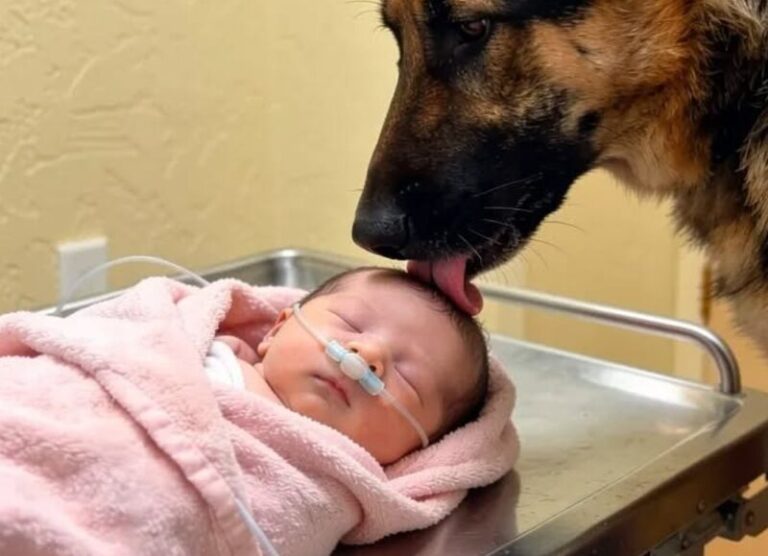
Hospital Investigation Intensifies After Dog’s Unusual Behavior Leads to Critical Discoveries in Infant Care Unit
A Mother’s Vigil Beside Her Son
The steady sound of medical machines echoed through the hospital room as six-month-old Lucas remained under constant observation in critical condition. For his mother, Sarah, the repeated beeping of monitors had become a painful reminder of how fragile her son’s situation had become.
She rarely left his side, spending hours seated near his crib while holding his tiny hand and watching for any sign of improvement. Every movement, every breath, and every small reaction carried enormous emotional weight.
Doctors had already explained that Lucas’s condition was severe. Despite ongoing treatment and advanced medical support, his body was struggling to recover as expected.
As the days passed, Sarah became emotionally exhausted but refused to give up hope. Medical staff eventually spoke to her about the possibility that continued aggressive treatment might not significantly change the outcome.
Those conversations deeply affected her. While doctors focused on medical realities, Sarah remained emotionally attached to the belief that her son was still fighting for his life.
A Deep Bond Outside the Hospital
Before Lucas was hospitalized, he had formed a strong connection with Rex, a German Shepherd known for his calm temperament and protective behavior. Since Lucas’s birth, the dog had remained constantly attentive to the baby.
Rex often rested near the infant’s crib at home and reacted quickly whenever Lucas cried or appeared uncomfortable. Sarah frequently described the relationship between the baby and the dog as unusually instinctive and emotional.
When Lucas was admitted to the hospital, Rex was left behind because animals were not permitted inside the critical care unit. The separation appeared to affect the dog noticeably.
According to Sarah, Rex became restless at home. He paced near doors, reacted to familiar sounds, and behaved differently after Lucas’s absence disrupted the household routine.
As Lucas’s condition worsened, Sarah increasingly believed that seeing Rex again might provide comfort for her son during a difficult time.
Hospital Regulations Prevent Animal Visits
Sarah repeatedly asked hospital administrators for permission to bring Rex into the facility. However, hospital policy prohibited animals from entering sensitive medical areas due to hygiene standards and patient safety requirements.
Staff members expressed sympathy for her situation but maintained that the rules could not be ignored. The pediatric care unit followed strict procedures intended to protect vulnerable patients.
Despite the denials, Sarah continued believing Rex’s presence might help emotionally, even if only briefly. She felt desperate as Lucas’s health remained uncertain.
Eventually, a nurse who sympathized with Sarah quietly supported the idea of allowing the dog inside for a short visit. Together with Rex’s handler, a discreet plan was arranged.
The decision was made privately and without official authorization. The goal was simply to allow a final emotional moment between the infant and the dog who had remained close to him since birth.
Unexpected Behavior Inside the Room
When Rex entered the hospital room, the atmosphere immediately changed. Rather than approaching Lucas calmly, the German Shepherd stopped near the doorway and carefully scanned the surroundings.
Witnesses noticed that the dog’s posture became tense and alert. Instead of focusing directly on the baby, Rex moved around the room with unusual precision.
He appeared especially interested in certain areas near medical equipment, supply bags, and sections of the wall beside Lucas’s crib.
The dog circled repeatedly while staring intensely toward one specific area of the room. At moments, he scratched near equipment and paused as if reacting to something hidden from human perception.
What was expected to be a peaceful reunion quickly became tense and uncertain.
The handler accompanying Rex immediately recognized that the dog’s behavior was abnormal. German Shepherds trained for protection and detection can sometimes respond strongly to environmental changes or hidden dangers.
Rex’s reaction did not appear emotional alone. It suggested that he had detected something unusual within the hospital environment.
Emergency Concerns Suddenly Emerge
Hospital personnel soon entered the room after learning that an unauthorized animal had been brought into the unit. Before staff could fully address the situation, an entirely different problem emerged.
The room lights flickered unexpectedly. Moments later, warning alarms briefly activated, and a faint burning odor spread through the area.
Medical staff quickly recognized that a technical issue was developing nearby. Concern immediately shifted from the unauthorized visit to patient safety.
Technicians were urgently called to inspect the room and surrounding infrastructure.
After examining the wall near the area where Rex had focused his attention, workers discovered overheating electrical wiring hidden behind the structure.
The malfunction posed a potentially serious fire risk within the pediatric care unit. Technicians later confirmed that the issue could have escalated significantly if it had remained undetected.
Rex’s persistent attention toward that exact section of the room suddenly took on much greater significance.
Additional Concerns Discovered
As hospital staff continued responding to the electrical issue, further inspections revealed additional concerns involving certain feeding supplies stored within the medical unit.
Some materials raised questions regarding contamination risks, prompting immediate precautionary measures.
Hospital personnel quickly removed the affected supplies while conducting a broader review of treatment procedures and storage protocols.
The findings intensified concern among staff members already dealing with the electrical malfunction.
Lucas and other vulnerable patients within the area were carefully reassessed to ensure no additional risks remained present.
Administrators began coordinating internal reviews while outside specialists were contacted to examine maintenance systems and supply handling procedures.
Lucas Is Moved to Safety
As a precaution, Lucas was transferred to another monitored environment within the hospital. Doctors adjusted his treatment plan while ensuring he remained under close observation.
For Sarah, the events unfolding around her felt overwhelming. She had entered the day fearing she might lose her son, only to witness a rapidly developing investigation involving safety failures and hidden hazards.
Although medical staff remained cautious, Lucas soon began showing small but meaningful signs of stabilization after the transfer.
Even minor improvements felt significant to Sarah after days of emotional despair.
Doctors emphasized that recovery remained uncertain, but the positive changes justified continuing intensive treatment efforts.
For the first time in days, Sarah felt a renewed sense of hope.
Hospital Launches Internal Investigation
The incident triggered a broader internal investigation within the hospital. Administrators began reviewing how the electrical malfunction had gone unnoticed and whether maintenance procedures had been properly followed.
Attention also focused on the feeding supplies identified during the emergency response.
Hospital leadership initiated reviews involving equipment oversight, supply chain handling, and safety compliance practices within the pediatric unit.
External specialists and technical personnel were brought in to assist with the investigation and ensure additional hazards were not present elsewhere in the facility.
The events prompted serious discussion among medical staff regarding emergency preparedness and environmental monitoring inside sensitive patient care areas.
What initially appeared to be a violation of hospital rules had unexpectedly led to discoveries that may have prevented a far more dangerous situation.
Staff Reconsider Their Initial Reactions
Many hospital employees who initially objected to Rex’s presence began reconsidering the situation after learning what technicians had uncovered.
The dog’s unusual behavior aligned closely with the areas later identified as problematic.
Several staff members discussed how Rex’s intense focus had directed attention toward dangers that were otherwise hidden behind walls and within equipment systems.
While no one suggested the dog intentionally solved the problem, his reactions became a central topic of conversation throughout the hospital.
For Sarah, the experience completely changed the way she viewed Rex. She no longer saw him only as a loyal pet but as an important presence in her son’s survival story.
What began as an emotional decision motivated by desperation had unexpectedly become part of a critical sequence of events.
Lucas Begins Showing Signs of Improvement
In the days following the incident, Lucas continued recovering under careful supervision. Doctors monitored his condition closely while continuing treatment in the safer environment.
The improvements remained gradual, but each positive development strengthened Sarah’s hope.
Meanwhile, repair work and safety corrections were implemented throughout the affected hospital areas.
The pediatric unit eventually stabilized after technicians completed electrical repairs and hospital staff reviewed supply procedures.
Although investigations remained ongoing, Sarah’s focus shifted entirely toward her son’s recovery and the possibility of bringing him home in the future.
The emotional impact of the incident remained strong for everyone involved.
An Unforgettable Chain of Events
Hospital workers, technicians, and family members later reflected on how quickly multiple hidden problems had been uncovered inside the medical unit.
The incident highlighted how unpredictable critical care environments can sometimes become, even under strict professional oversight.
For many involved, the most remarkable aspect of the story was the unusual sequence that led to the discoveries.
What began as a mother’s emotional wish to reunite her child with a beloved companion eventually resulted in the identification of serious hidden risks.
Rex’s behavior, initially viewed as disruptive and unauthorized, ultimately became connected to the discoveries that followed.
Sarah later described the experience as life-changing. She said the events strengthened her belief that awareness and protection can sometimes come from unexpected places.
A Lasting Emotional Impact
As Lucas continued recovering, Sarah frequently reflected on the terrifying uncertainty she had faced during his hospitalization.
She remembered entering the hospital room believing she might be witnessing her son’s final days, only to experience a dramatic turn of events that changed everything.
The emotional bond between Lucas and Rex became even more meaningful after the incident.
For Sarah, the German Shepherd’s actions represented more than instinct alone. They symbolized loyalty, awareness, and a connection that seemed impossible to explain fully.
Although medical treatment remained essential to Lucas’s recovery, the events surrounding Rex’s visit left a lasting impression on everyone who witnessed them.
In the end, the story became not only about a critically ill infant and a hospital investigation, but also about the unexpected role instinct and observation played during a moment of crisis.

