
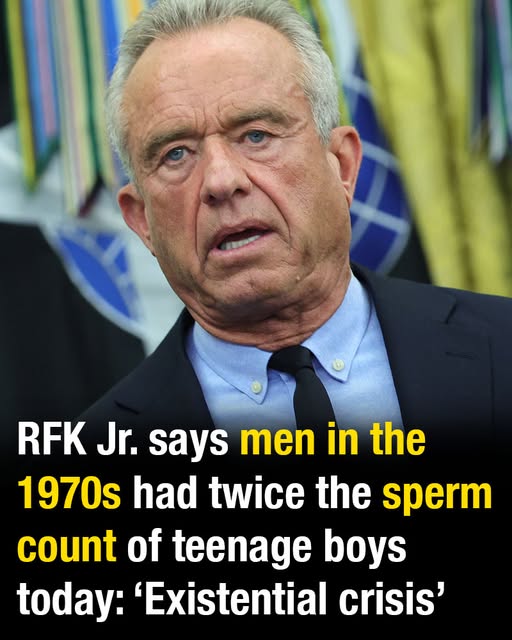
Robert F. Kennedy Jr. Warns of “Existential Crisis” Over Declining U.S. Birth Rates
Rising Concern Over Fertility Trends in the United States
Health and Human Services Secretary Robert F. Kennedy Jr. has raised concerns about what he describes as a major national issue tied to America’s declining birth rate. Speaking at a White House event on Monday, he characterized the trend as an “existential crisis” with potential long-term implications for both the economy and national security.
Kennedy emphasized that the issue extends beyond demographics, framing it as a broader public health challenge linked to fertility and environmental conditions affecting reproductive health across the population.
“It’s a threat not only to our economy,” he said, while also adding that it affects “our national security.”
Factors Under Review in Fertility Research
During his remarks, Kennedy stated that the department is examining a range of possible contributors to fertility changes. These include obesity, metabolic health, pesticide exposure, endocrine-disrupting chemicals, and environmental influences he referred to as a “toxic soup that our young women are walking around in.”
He pointed to data suggesting that the decline in fertility rates among women began around 2007, noting that national birth rates have generally continued to decrease since that period.
The comments reflect growing attention within public health discussions about the potential interaction between environmental conditions and reproductive health outcomes, though the exact causes remain the subject of ongoing research.
Concerns Over Male Reproductive Health
Kennedy also highlighted concerns related to male fertility, arguing that sperm counts have significantly declined over time. He referenced historical comparisons suggesting a sharp reduction in sperm levels among younger generations.
“In 1970, men had twice the sperm count as our teenagers do today,” Kennedy said, describing the situation as an “existential crisis for our country.”
His remarks align with discussions surrounding a 2022 scientific review published in Human Reproductive Update, which examined global sperm count trends. However, the research did not specifically focus on teenage populations, and interpretations of long-term reproductive data remain widely debated within the scientific community.
Kennedy has previously made similar claims in public interviews, repeatedly emphasizing concerns about declining reproductive health metrics. In earlier statements, he also linked fertility trends to hormonal differences across generations, stating that “a teenager today, an American teenager, has less testosterone than a 68-year-old man.”
Scientific Debate Remains Ongoing
Despite increasing public discussion, experts note that the scientific understanding of sperm count trends is not definitive. While some studies suggest a downward trajectory, researchers caution that long-term reproductive data is difficult to measure consistently across different populations and time periods.
Some specialists argue that conclusions about global fertility decline should be approached carefully due to variations in methodology, sampling, and historical data collection practices.
“The idea of a global decrease in sperm count is ‘an important hypothesis, but the data is not good [enough] to be able to draw conclusions,’” said Dolores Lamb, a reproductive health researcher at Weill Cornell Medicine.
This perspective highlights the ongoing debate within the scientific community regarding how reproductive health trends should be interpreted and whether current evidence is sufficient to confirm long-term global declines.
Policy Interest and Government Focus
The issue of declining birth rates has also become increasingly prominent in political discussions. Broader concerns about population trends have drawn attention from policymakers who view fertility rates as an important factor in economic planning and workforce stability.
Former President Donald Trump has also indicated that addressing falling birth rates would be a policy priority during his second term. This focus reflects growing political interest in demographic changes and their potential long-term consequences for national development.
Over the weekend, the Trump administration proposed a new rule aimed at expanding access to fertility-related workplace benefits. The proposal is intended to make it easier for employers to offer support programs connected to reproductive health and family planning.
Broader Implications of Declining Birth Rates
The discussion surrounding fertility trends reflects wider concerns about population stability and its impact on economic growth. A sustained decline in birth rates can influence workforce size, aging demographics, and long-term social support systems.
Public health officials and policymakers continue to monitor these trends closely as part of broader demographic planning. While interpretations differ, the issue has increasingly become part of national policy discussions focused on health, environment, and economic sustainability.
Kennedy’s remarks contribute to this ongoing conversation by highlighting potential environmental and biological factors that may be influencing reproductive health. At the same time, scientific research continues to explore these questions without reaching a definitive consensus.
Continuing National Debate
The topic of declining birth rates and reproductive health remains an evolving issue in both scientific and political spheres. While concerns have been raised about environmental exposure, lifestyle factors, and physiological changes, experts emphasize that the full picture is complex and not yet fully understood.
As research continues, policymakers and health officials are expected to remain engaged in discussions about how best to interpret fertility trends and what actions, if any, may be appropriate in response.
For now, the issue remains a significant point of national debate, shaped by scientific uncertainty, policy interest, and growing public attention to long-term demographic change.

