
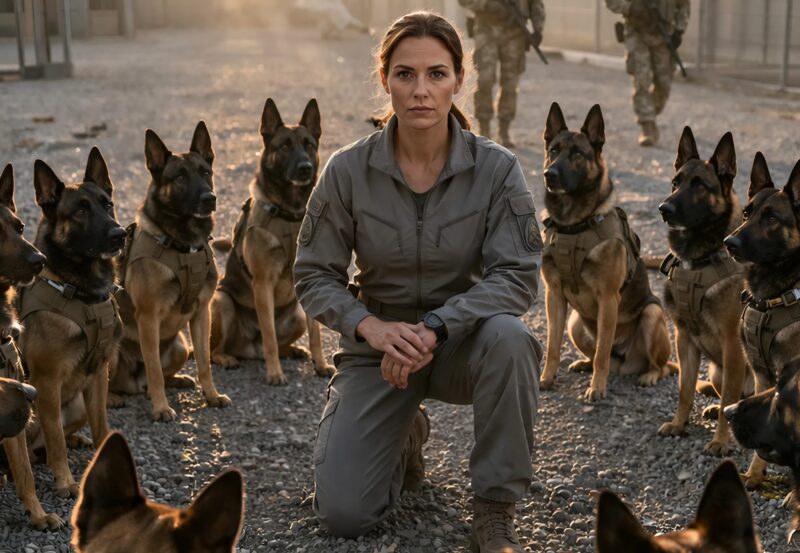
At the naval base, the morning began like any other. A low coastal fog hung over the concrete paths, and the air carried the familiar mix of saltwater and fuel. Personnel moved with routine precision, each following assigned duties without unnecessary interaction. Among them, a woman in a worn service jumpsuit walked slowly, pushing a metal cart filled with tools. The wheels rattled faintly over the uneven ground, and a faded patch on her chest read “R. Collins.” To most people on base, she was just another maintenance worker, someone easily overlooked in the structure of daily operations.
She kept her head down, focused on her task, moving between sections of the facility with calm efficiency. Nothing about her appearance suggested attention, and for a while, she passed unnoticed as usual.
That changed when a senior officer observed her from a distance. Known for strict discipline and an uncompromising attitude toward protocol, he quickly fixated on a minor irregularity: a delayed response at a restricted passage point, followed by what he perceived as an insufficiently formal reply. In his view, it was not the mistake itself that mattered, but the tone and confidence behind it.
He called her over.
The exchange that followed was brief but tense. The officer spoke sharply, emphasizing procedure and obedience. The woman listened without interrupting. When she responded, her voice was steady and controlled, without apology or visible hesitation. That composure seemed to irritate him further, and the surrounding personnel began to notice the shift in atmosphere.
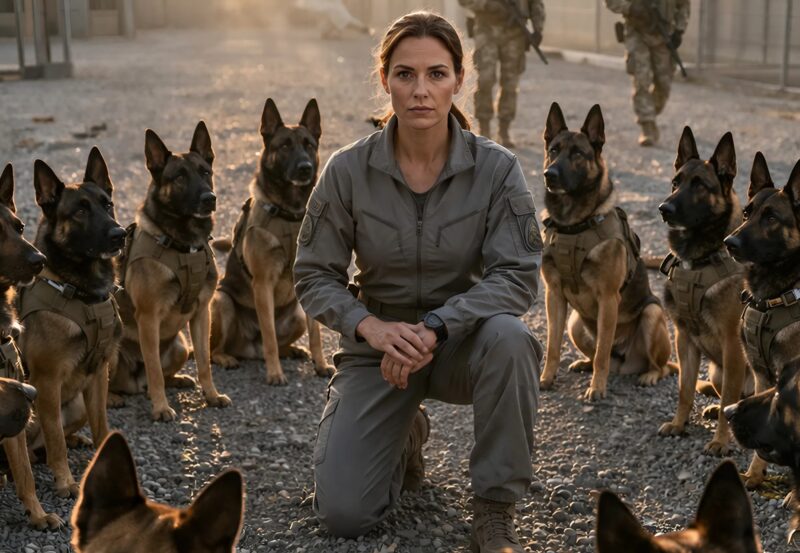
Within moments, the situation escalated beyond a routine reprimand. The officer’s authority was absolute in that environment, and he decided to make an example of what he considered insubordination. With a curt signal, he ordered the canine unit to be brought in.
Fifteen military working dogs were led onto the training ground. They were Belgian Malinois, fully equipped with tactical harnesses, trained for obedience, protection, and controlled engagement. Each dog was handled by an experienced handler, and together they formed a coordinated unit designed to respond instantly to command.
The dogs were positioned in a wide formation facing the woman. Their focus was immediate. Muscles tense, posture aligned, eyes locked forward. The handlers tightened their grips on the leashes, waiting for the final order. The atmosphere shifted noticeably, and the nearby personnel stepped back to create space.
The officer raised his hand and issued the command.
The word “attack” cut through the air.
For a moment, nothing happened.
The dogs remained still.
There was no surge forward, no barking, no breaking formation. Only silence followed the command. The handlers exchanged brief, uncertain glances. The officer repeated the order, his voice sharper, more forceful.
“Attack.”
Again, there was no response.
A long second passed, then another. The tension in the air grew heavier, as if the entire formation was resisting something unseen. The dogs remained alert, but their attention was no longer directed in the way the officer intended.
Then the formation shifted.
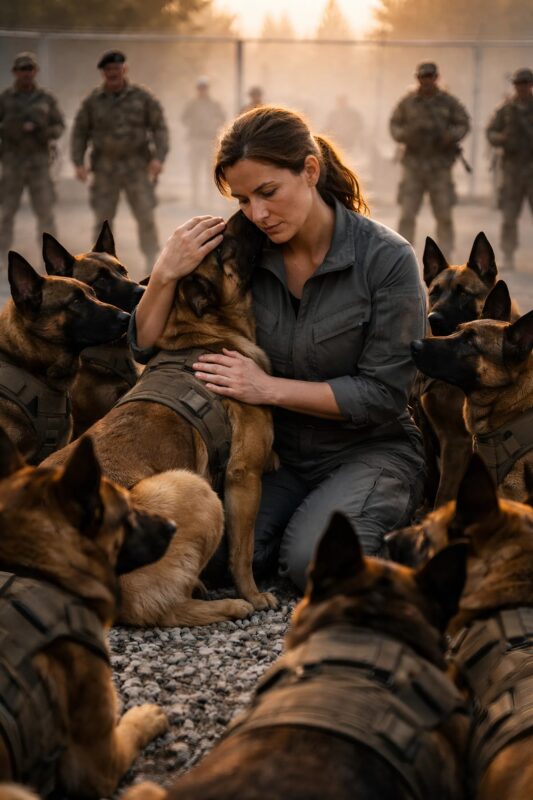
All fifteen dogs moved at once, but not in the direction expected. Instead of advancing, they stepped into a tighter configuration around the woman. Their positioning changed with precision, forming a protective perimeter rather than an offensive line. Their bodies lowered slightly, not in aggression, but in alert defense.
The handlers froze. The officer’s expression hardened as he tried to process what he was seeing.
The woman did not move away. She slowly knelt down in the center of the formation, her posture calm and unthreatened. She extended her hands carefully, and one of the dogs approached her first. Then another followed. Within seconds, the tension dissolved into familiarity.
The dogs were not reacting to a stranger. They were responding to recognition.
One rested its head against her shoulder. Another pressed gently against her side. A third leaned into her hand as she stroked its neck. The entire formation softened, shifting from military discipline to instinctive trust.
The silence that followed was different from before. It was no longer filled with anticipation of violence, but with confusion and disbelief. Those watching began to realize that this was not a random reaction. These animals were responding to someone they knew.
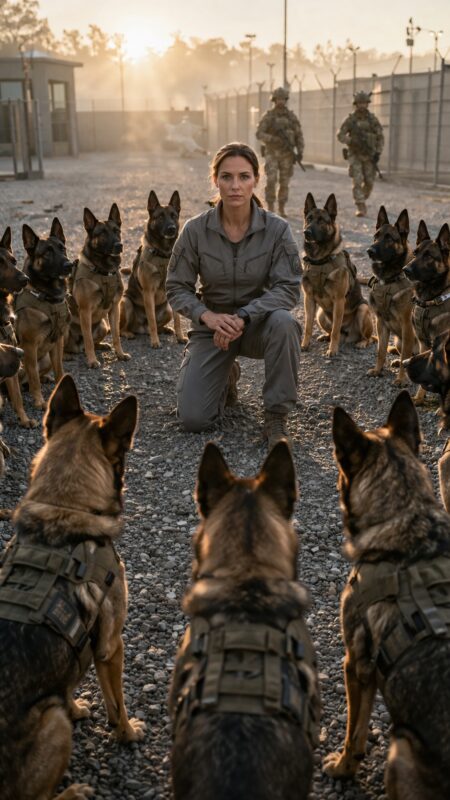
The woman’s movements confirmed it. Her handling was precise, controlled, and instinctive, the kind developed through long-term training experience. She spoke quietly to the dogs, using minimal gestures that they clearly understood.
It became apparent that she had once been part of the unit’s training program. She had worked directly with these dogs in earlier stages of their service, building the behavioral conditioning and operational trust that shaped their responses. Although she had since left active duty and moved into a lower-profile maintenance role, the connection had not disappeared.
The dogs remembered.
The officer stood motionless, the authority of his command suddenly ineffective in the face of a bond formed long before his intervention. The situation he intended to control had shifted completely, not through defiance, but through recognition and memory embedded in training and experience.
The formation that was meant to execute an order had instead become a protective circle around the woman.
No further commands were issued.
And in that moment, the base was reminded that discipline in a military environment is not built on fear alone, but also on trust, history, and the relationships formed between handlers and the animals they train.

