
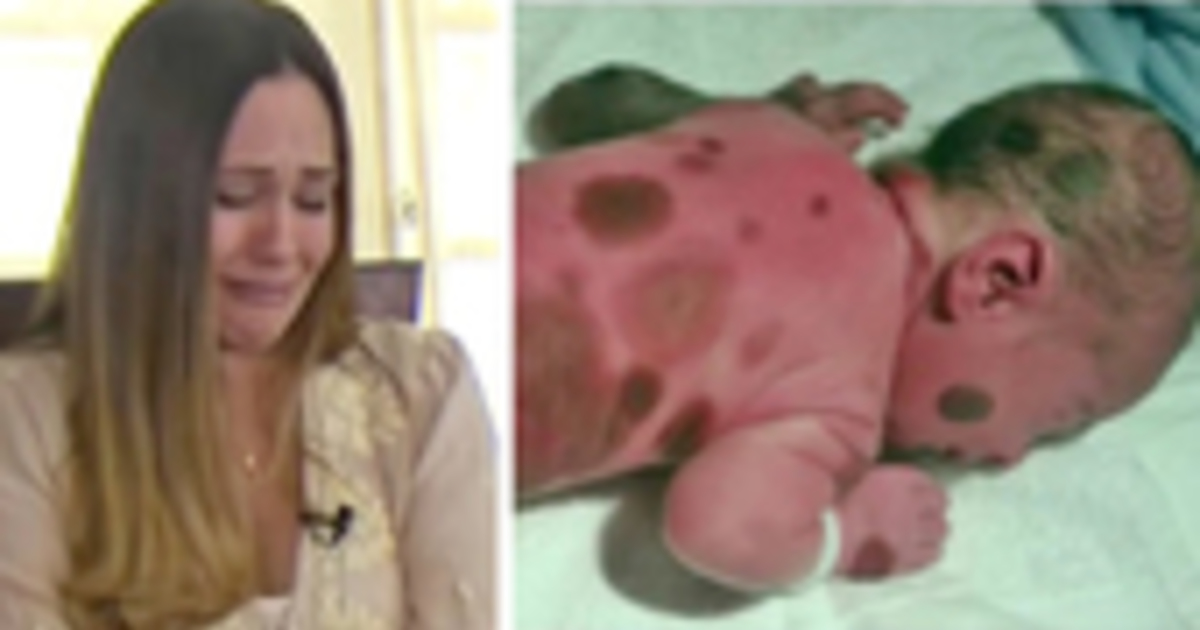
Stephanie and Dan Dworksy experienced a moment of surprise and uncertainty when they first saw their newborn son, Kacy. Like many parents, they had spent months preparing for his arrival, focusing on a healthy pregnancy and hoping for a smooth start to his life. However, when Kacy was born, it became immediately clear that he had a rare skin condition that would shape their journey in unexpected ways.
Kacy was born with a condition known as congenital melanocytic nevus, a rare skin disorder characterized by large, darkly pigmented areas that can appear across different parts of the body. In his case, the markings were extensive. He had a prominent nevus on his arm, along with multiple smaller spots, often referred to as “satellites,” distributed across his body, including his face, legs, and back. For his parents, the visual impact of the condition was striking, especially in those first moments after birth.
Medical professionals explained that this condition is uncommon, affecting a very small number of individuals worldwide. They also noted that while it can be associated with certain health considerations, including an increased risk of skin-related complications, many of its effects are primarily visible rather than physically limiting. Still, the rarity of the condition meant that the family had little prior understanding of what it might involve.

For Stephanie, the emotional impact was significant. Despite following all recommended guidelines during pregnancy, she found herself questioning whether she could have done something differently. These feelings, while common among parents facing unexpected medical situations, added to the challenge of adjusting to a new reality. Over time, she came to understand that such conditions are not caused by anything a parent did or did not do, but the initial uncertainty was difficult to navigate.
Dan and Stephanie also began thinking about how their son’s appearance might affect his experiences as he grows. Medical staff prepared them for the possibility that people might react with curiosity or misunderstanding, especially because the condition is not widely recognized. They were told that children and even adults might ask questions or make comments simply due to a lack of awareness.
These concerns led to moments of hesitation in daily life. Stephanie has spoken about feeling anxious in public settings, worried about how others might respond. Like many parents, her instinct was to protect her child from potential discomfort, even when that meant limiting certain outings. At the same time, she recognized that avoiding the outside world was not a long-term solution.
Gradually, the family began shifting their perspective. Instead of focusing only on the challenges, they decided to use their experience as an opportunity to inform others. They started sharing their story in order to increase understanding of rare skin conditions like congenital melanocytic nevus. Their goal has been to encourage people to look beyond appearance and to approach differences with curiosity and kindness rather than judgment.
Raising awareness became an important part of their journey. By speaking openly, they hoped to reduce misconceptions and help others recognize that children like Kacy are not defined by their condition. They emphasized that, aside from the visible markings, he is like any other child—growing, learning, and developing his own personality.
The family’s efforts also highlight a broader issue related to rare conditions. When something is not commonly seen, it can sometimes lead to misunderstanding or unnecessary concern. Education plays a key role in addressing this. By providing accurate information and sharing real-life experiences, families and advocates can help create a more informed and supportive environment.
Kacy’s story is not only about a medical condition but also about how families adapt and respond to unexpected circumstances. It reflects the emotional complexity that can come with parenting, especially when faced with something unfamiliar. At the same time, it demonstrates how awareness and openness can gradually change perceptions.
As Kacy continues to grow, his parents remain focused on creating a positive and supportive environment for him. Their message is centered on understanding and acceptance. They hope that by sharing their experience, more people will become aware of conditions like his and respond with empathy rather than uncertainty.
Ultimately, their story serves as a reminder that visible differences do not define a person’s worth or potential. Through their efforts, they aim to contribute to a broader conversation about inclusion, encouraging others to see beyond appearance and recognize the individuality of every child.

