
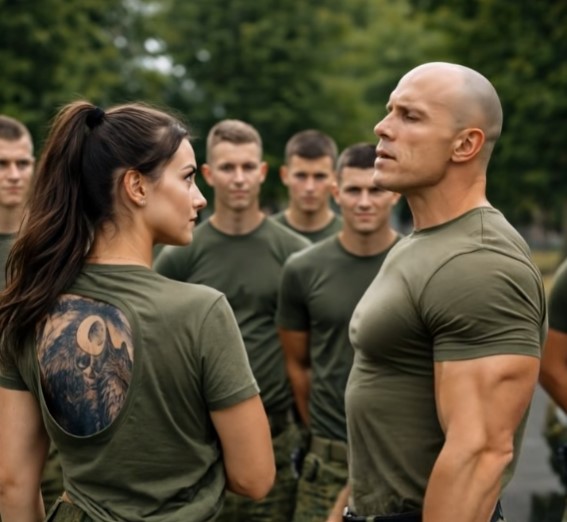
The training ground was already active when Olivia arrived, filled with the noise and movement of recruits preparing for another demanding day. Her entrance did not create the kind of attention that some might expect in such an environment. Instead of being met with immediate recognition or curiosity, she blended into the surroundings in a quiet and almost unnoticed way. There was nothing about her presence that suggested an attempt to stand out. She carried a worn backpack and wore simple, practical clothing that did not match the more polished and carefully maintained appearance of many of the other recruits.
At first glance, she appeared out of place, as if she had entered a structured and disciplined setting that demanded more confidence and experience than she outwardly showed. Within moments of her arrival, subtle conversations began forming among the group. These early reactions were not based on knowledge of her abilities or background, but rather on quick visual assumptions. In environments like this, first impressions often carry significant weight, and in Olivia’s case, those impressions quickly shaped the way others initially perceived her.
As the morning continued, the quiet observations turned into more open discussion among the recruits. Some individuals expressed doubt about her presence in the program, while others treated her arrival as something unusual or even questionable. The atmosphere gradually shifted from neutral observation to subtle exclusion. By the time the group had fully assembled for the day’s activities, Olivia had already become a topic of quiet judgment.
During group briefings and early training routines, she remained largely unacknowledged. Instead of being included in conversations or treated as a familiar part of the team, she was often overlooked or indirectly dismissed. The situation became more noticeable during breaks, particularly in the cafeteria, where social dynamics were more visible. At one point, a recruit deliberately approached her table in a manner that drew attention from nearby groups. His behavior appeared intended to entertain others by making her the focus of a joke. This moment caused several recruits to laugh, reinforcing an atmosphere where she was treated as an outsider rather than a participant.
Despite this public display of mockery, Olivia did not respond with visible frustration or confrontation. She maintained a composed and controlled demeanor, continuing her meal without engaging in the surrounding behavior. Her silence stood out in contrast to the noise around her, but it did not immediately change how others viewed her. Instead, some interpreted her lack of reaction as uncertainty or weakness, reinforcing their assumptions rather than questioning them.
As training activities resumed, Olivia’s behavior remained consistent. She followed instructions carefully and completed each assigned task without drawing attention to herself. She did not engage in arguments, nor did she attempt to defend herself verbally against the treatment she received. Instead, she focused entirely on the demands of the training environment. This approach continued during physical exercises, where she was occasionally subjected to unnecessary roughness from other recruits. Some of these actions appeared intentional, designed to disrupt her performance or make her struggle more visibly. Even when she was knocked off balance or placed at a disadvantage, she would quietly recover and continue without complaint.
Over time, this behavior began to create uncertainty among some members of the group. While many still viewed her as inexperienced or unprepared, a few started to question whether her calm response indicated something deeper than passivity. There was a growing sense that her silence might not be a sign of weakness, but rather a form of control that was not yet understood.
As the training program progressed, the intensity of the exercises increased. The physical and mental demands became more challenging, requiring greater focus, endurance, and cooperation among participants. It was during these more complex exercises that the dynamics within the group became more strained. Tensions that had previously been subtle began to surface more clearly, especially in situations where coordination and trust were essential.
During one navigation exercise, Olivia was temporarily placed at a disadvantage when essential equipment was removed during a group rotation. This forced her to continue without the tools others relied on, relying instead on her observation skills and memory. Despite the setback, she maintained steady progress and completed the exercise without complaint. While others struggled with frustration or confusion, she remained focused and consistent in her approach, which gradually began to draw quiet attention from some observers.
The most significant moment of the day occurred during a controlled combat simulation designed to test reaction speed, decision-making, and coordination under pressure. In this high-intensity environment, interactions between recruits became more physical and unpredictable. During one exchange, a forceful movement by another participant caused Olivia’s clothing to tear. The incident was not immediately recognized as anything beyond a training accident, but it resulted in an unexpected and significant revelation.
As a result of the tear, a large tattoo became visible across her upper back and shoulder area. The design was detailed and carefully constructed, featuring symbols that were unfamiliar to most of the recruits present. However, its significance was immediately recognized by senior personnel observing the exercise. One senior officer in particular reacted instantly, his attention shifting sharply toward Olivia upon seeing the markings. His professional demeanor changed, becoming more focused and serious as he approached the scene.
A sudden silence spread across the training ground. The recruits, who had been engaged in active movement only moments earlier, stopped to observe the change in atmosphere. It was clear that the tattoo carried meaning beyond personal expression, as the officer’s reaction suggested recognition of something important connected to training history or operational experience.
Although no explanation was immediately given to the group, the response from the officer implied that Olivia’s background was far more extensive than anyone had assumed. The markings suggested involvement in advanced training or specialized units that required discipline, trust, and significant operational experience. This realization began to reshape the way she was perceived by those around her.
The behavior that had previously been dismissed as quietness or lack of engagement was now reconsidered in a different light. What had seemed like passivity was now interpreted by some as restraint, awareness, and control. Her silence throughout the day began to take on new meaning, suggesting not inexperience, but rather observation and calculated composure.
As the implications of this revelation became clearer, the atmosphere among the recruits changed noticeably. The earlier laughter and dismissive behavior faded, replaced by uncertainty and reflection. Those who had participated in mocking or excluding her now appeared more cautious, reconsidering their actions in light of what had been revealed.
A collective realization began to form that initial judgments had been based on incomplete understanding. The assumption that appearance reflected ability had led to a misinterpretation of her role within the group. This shift in perception created a quiet but noticeable tension, as individuals processed the difference between what they had believed and what was now suggested by evidence of her background.
By the end of the training session, the environment had changed significantly. The earlier confidence and casual disregard had been replaced with a more thoughtful and restrained atmosphere. Recruits interacted more carefully, aware that their assumptions had not accurately reflected reality.
Olivia, however, did not acknowledge the shift in how she was perceived. She continued with her routine without drawing attention to the events of the day. Her focus remained steady, and she did not attempt to address or highlight what had occurred. In this sense, the moment passed without direct explanation, leaving its impact to settle naturally among those who witnessed it.
The events of the day ultimately highlighted an important lesson about perception within structured and high-pressure environments. Judgments based solely on appearance can often lead to incomplete or incorrect conclusions. Experience, capability, and history are not always immediately visible, and in some cases, they only become apparent when unexpected circumstances reveal them.
Olivia’s presence served as a reminder that strength is not always expressed through words or outward confidence. Sometimes it is demonstrated through composure, discipline, and the ability to remain steady under pressure. The tattoo, while significant, functioned less as a dramatic reveal and more as a confirmation of depth that had gone unrecognized.
In the end, the situation was not defined by confrontation or conflict, but by realization. It showed how quickly understanding can change when hidden experience comes to light, and how easily assumptions can be challenged when reality proves more complex than first impressions suggest.

