
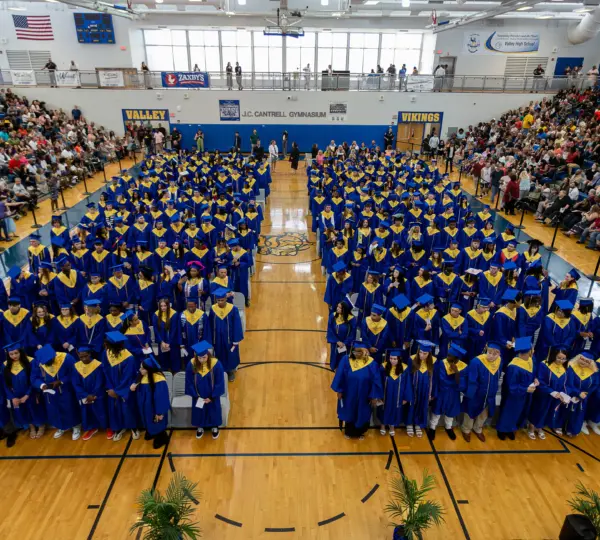
The gymnasium carried the layered energy of a graduation afternoon—chairs shifting, families calling out softly, and cameras capturing every passing moment. Blue and gold decorations hung from the rafters, and rows of students sat in their caps and gowns, trying to hold steady between nerves and pride. The air was warm with flowers and formal fabric, the kind of atmosphere that tends to stay in memory long after the day has passed.
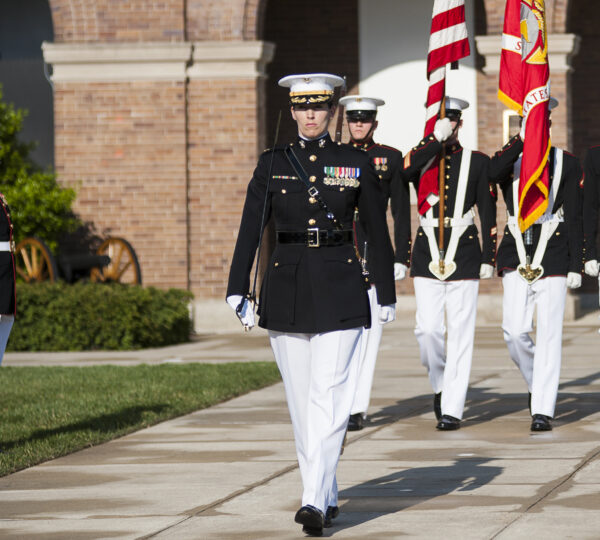
When retired Marine Sergeant Solomon Dryden entered through the gym doors in his dress uniform, the room subtly changed. It wasn’t dramatic, but noticeable enough that conversations lowered and a few heads turned. He didn’t acknowledge the attention. He wasn’t there for recognition. He was there for something far more personal—a promise made years earlier.
That promise had been made to his late wife. Before she passed, she had asked him to be present for their son Tyran’s graduation. It wasn’t a grand request, but a simple one, spoken with certainty and love. Solomon had carried it with him ever since, alongside a worn photograph he kept inside his jacket pocket—an image of his wife holding a much younger Tyran, both smiling in a moment that belonged to another time.
For Solomon, that photograph represented more than memory. It represented responsibility that continued beyond loss.
Solomon’s life had been shaped by service in the United States Marine Corps. Two decades of discipline, deployments, and distance had defined much of his world. He had learned to live with separation from home, marked by brief calls, letters, and the quiet discipline of duty. Through it all, he remained steady in two commitments: service to his country and devotion to his family.
His time at home, though limited, was intentional. He taught Tyran the basics of discipline and respect—how to shake a hand properly, how to stand during the national anthem, how to carry himself with quiet confidence. These lessons were never presented as commands, but as examples.
When his wife became ill and eventually passed away after a long illness, Solomon’s life shifted into something quieter and more focused. Grief did not weaken his sense of direction; instead, it reinforced it. He had made a promise, and that promise became his anchor.
On the day of graduation, Solomon took his seat among other families. He blended into the crowd despite his uniform, observing the ceremony with quiet focus. The school band played, and students began to file in, their movements a mix of excitement and restraint.
When Tyran appeared, Solomon felt the moment sharpen. His son walked with calm confidence, taller now, carrying himself with a maturity that had developed over years rather than months. For Solomon, it was not just a student entering a ceremony. It was the continuation of a life he had helped shape.

As names were called and applause filled the gym, Solomon remained still, watching closely. Each name represented years of effort, but his attention returned again and again to Tyran, waiting for his moment.
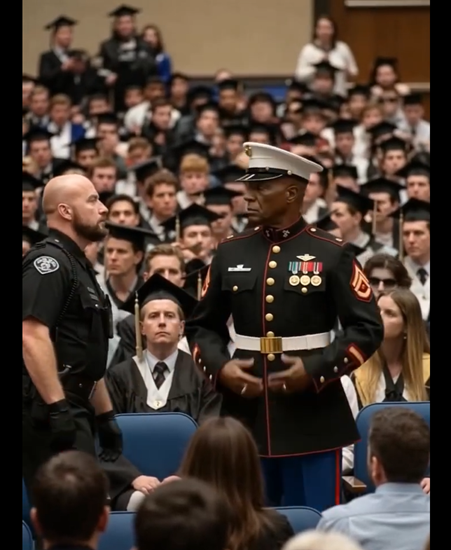
That moment came when two security officers approached Solomon’s row. Their tone was professional but cautious. They asked to verify his credentials due to concern over the uniform. It was not hostility, but protocol shaped by awareness and caution in public spaces.
Solomon responded calmly, reaching for his identification without resistance or tension. Years of military experience had taught him that clarity prevents escalation. Around them, nearby families began to notice the interaction, curiosity spreading quietly through the rows.
Before the situation could progress further, movement came from the student section.
Six young men stood together. They wore matching Navy shirts, a quiet but deliberate sign of their future plans. Each had already committed to military service after graduation. One of them stepped forward and spoke clearly, identifying Solomon as Tyran’s father and explaining that his presence had been a source of inspiration for their decisions.
The gym fell into silence.
What followed was not confusion, but recognition. The principal approached, reviewed the situation, and confirmed Solomon’s identity. The misunderstanding was resolved quickly, and she stepped to the microphone to acknowledge him publicly. She thanked him for his service, and the room responded with a standing ovation.
Solomon did not react dramatically. He acknowledged the moment with a slight nod, his expression composed. Yet beneath that restraint was something deeper—quiet emotion tied not to attention, but to meaning. His son had reached a milestone, and others had been influenced along the way.
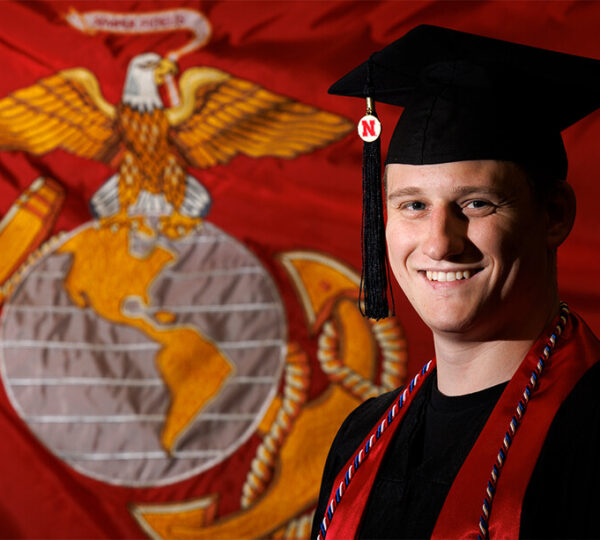
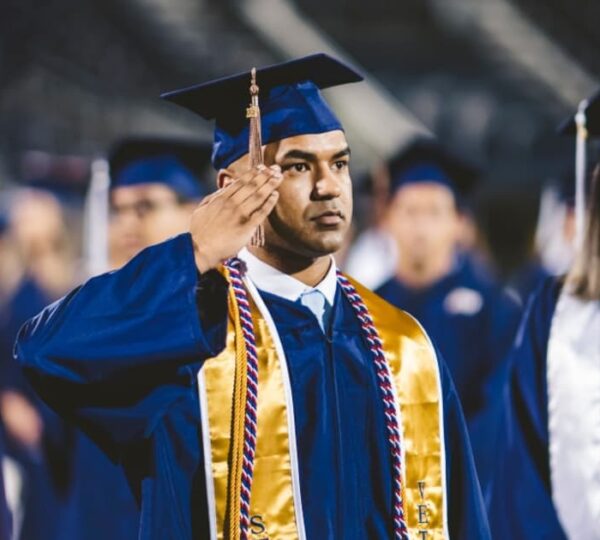
When Tyran’s name was called, the moment felt slower, almost suspended. He crossed the stage, accepted his diploma, and turned instinctively toward the audience. His gaze found his father immediately.
Solomon stood with a hand placed over his heart. No words were exchanged between them, but none were needed. The connection between them carried everything that mattered in that instant—years of effort, absence, discipline, and care.
After the ceremony, families gathered for photographs and conversation. The six young men approached Solomon again, this time speaking more personally. They expressed gratitude and shared how observing Tyran’s upbringing had influenced their own decisions to enlist. Solomon listened without interruption, offering measured responses rooted in experience rather than sentiment.
He reminded them that service requires discipline, preparation, and humility, and that the reality of it extends far beyond ceremony or symbolism. His words were not meant to discourage, but to ground their decisions in understanding.
As the day ended and the crowd slowly dispersed, Solomon remained for a moment in his car. He removed the photograph from his pocket and looked at it quietly. In that stillness, he acknowledged what the day represented—not achievement in the traditional sense, but fulfillment of responsibility carried over time.
The journey to that moment had not been simple. It had included absence, loss, and years of balancing duty with fatherhood. But it had also been marked by consistency—showing up when possible, guiding when needed, and remaining present in principle even when physically distant.
The true significance of the day was not in applause or recognition, but in continuity. Tyran had reached a milestone shaped by both his own effort and the values passed down to him. Those values were not spoken often in grand terms. They were demonstrated in everyday actions: discipline, respect, and perseverance.
As a parent and a Marine, Solomon’s influence had not been built on attention, but on example. And in that example, others had found direction.
The story ends not with celebration alone, but with quiet understanding. A promise was kept. A son moved forward. And a legacy continued not through words, but through lived experience carried from one generation to the next.

