
The Old Iron Farm Tool With Teeth That Helped Shell Corn by Hand
Old barns, sheds, and farm storage buildings often contain objects that seem unfamiliar at first glance. Hidden beneath layers of dust and rust, or tucked away on forgotten shelves, there are tools that once played an important role in everyday agricultural life. Many of these items no longer have a place in modern farming, which is why they can appear mysterious today. However, each one was originally designed with a clear and practical purpose.
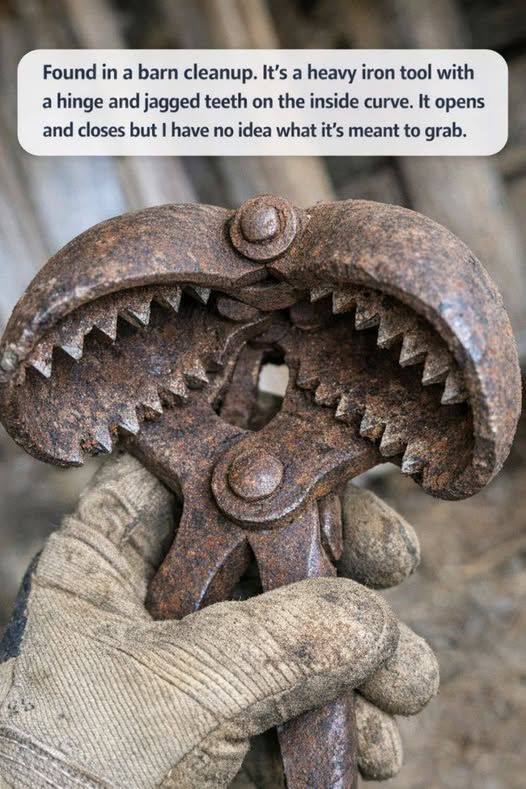
One such object is a heavy iron tool featuring a central hinge and curved jaws lined with small, evenly spaced teeth. At first sight, it may be difficult to identify. Its shape can seem unusual, and its solid metal construction may make it look more like an industrial relic than a household farming implement. Yet, every part of its design served a specific function.
A Closer Look at Its Design
The most noticeable feature of this tool is the inner row of jagged teeth along its curved jaws. These teeth are not random or decorative. They were carefully shaped to grip and pull material from a rounded surface. This detail is the key to understanding its purpose: it was used as a traditional handheld corn sheller.
Before the introduction of modern agricultural machinery, farmers had to rely on manual tools for many tasks. One of these tasks was removing kernels from dried corn cobs. This process, known as shelling corn, required significant time and effort when done entirely by hand. Tools like this iron sheller were developed to make the job faster and less physically demanding.
The curved shape of the jaws allowed the tool to wrap partially around a corn cob. This ensured that pressure could be applied evenly across multiple rows of kernels. The hinge in the center gave the tool flexibility, allowing it to open and close depending on the size of the cob being processed.
A Common Find in Old Farm Structures
It is not unusual to discover such tools while cleaning out old barns or storage buildings. Many of these items have remained untouched for decades, left behind as farming practices evolved. As technology advanced, manual tools were gradually replaced by machines, leaving behind physical reminders of earlier methods.
A hinged iron tool with toothed jaws might seem confusing at first glance. Its weight suggests durability, while its shape hints at a specialized function. These characteristics indicate that it was designed for repeated use in demanding conditions. Farm tools were expected to last for years, often being passed down through generations.
The corn sheller fits this description well. It was built to withstand constant pressure and friction, as it was used repeatedly during harvest seasons when large quantities of corn needed to be processed.
Understanding the Role of the Teeth
The small, sharp teeth inside the jaws are the defining feature of the tool. While they may resemble cutting edges, their purpose was not to slice through material. Instead, they were designed to grip and dislodge kernels from the surface of a corn cob.
Dried corn kernels are tightly attached to the cob, making them difficult to remove by hand. The teeth of the sheller helped solve this problem by applying concentrated pressure. When the tool was closed around a cob and moved along its surface, the teeth would catch the kernels and loosen them from their positions.
The curved jaws allowed the tool to maintain contact with the cob as it was rotated. This ensured that kernels could be removed in sections, making the process more efficient and consistent than manual picking.
How the Tool Was Used
The operation of a handheld corn sheller was relatively simple. A dried corn cob was placed between the open jaws of the tool. The user would then squeeze the handles together, allowing the teeth to grip the outer rows of kernels.
Once secured, the tool was moved along the length of the cob or rotated around it. As this motion continued, the teeth would strip kernels away in strips or clusters. After one section was completed, the cob could be turned and the process repeated until all kernels were removed.
Although the task still required physical effort, the tool significantly reduced the time needed to complete it. This made it especially valuable on farms where large quantities of corn had to be processed during harvest season.
The Importance of Corn Shelling in Farming
Corn has long been an essential crop in agricultural communities. After harvesting, the kernels often needed to be separated from the cob before they could be stored or used. This process was necessary for both human consumption and animal feed preparation.
Manual shelling without tools was slow and repetitive. Farmers and their families would spend hours removing kernels by hand. Tools like the iron corn sheller improved efficiency and reduced the physical strain associated with the task.
Even small improvements in speed were important in traditional farming life. Labor was intensive, and any tool that reduced effort or saved time was highly valued. The corn sheller became a practical solution for a routine but necessary job.
A Tool Built for Durability and Function
The construction of the sheller reflects the demands of farm life. Made from solid iron, it was designed to endure heavy use and harsh conditions. Tools were often exposed to outdoor environments, barns, and storage areas where durability was essential.
The simplicity of its design is also significant. There are no complex parts or mechanisms. Instead, the tool relies on shape, leverage, and manual force to perform its function. The hinge provides movement, while the teeth provide grip. Together, they create an effective mechanical system.
This simplicity is a hallmark of many traditional farm tools. They were designed to be practical, repairable, and long-lasting, rather than complex or disposable.
Why the Tool Appears Unfamiliar Today
Modern agricultural methods have greatly reduced the need for manual shelling tools. Today, corn is often processed using large machines that can handle the task quickly and efficiently. As a result, tools like the handheld corn sheller are no longer commonly used.
This change in technology is one reason why such objects may seem unfamiliar when discovered today. Without context, their purpose is not immediately clear. Their appearance can resemble clamps, traps, or general-purpose metal tools rather than specialized farm equipment.
However, a closer examination of their structure reveals their original function. The curved jaws and toothed interior surface clearly indicate that the tool was designed to grip and process a rounded object, such as a corn cob.
A Reflection of Past Labor
The handheld corn sheller represents a time when farming relied heavily on manual effort. Each task, no matter how small, required time, patience, and physical work. Tools like this were essential in making daily agricultural routines more manageable.
It also reflects a period when tools were designed with a single, clear purpose. There was no unnecessary complexity. Every feature served a direct function, and efficiency was achieved through mechanical simplicity.
Discovering such a tool today offers a glimpse into that earlier way of life. It highlights how much labor was involved in tasks that are now automated and shows how innovation gradually reduced the physical demands of farming.
Conclusion
The heavy iron tool with curved jaws and sharp internal teeth is a traditional handheld corn sheller. Its design was carefully developed to remove kernels from dried corn cobs more efficiently than manual methods alone.
By combining a hinged structure with toothed gripping surfaces, it allowed farmers to complete a repetitive and time-consuming task with greater ease. Although it may appear unfamiliar in modern settings, its purpose was both practical and essential in its time.
Today, it stands as a reminder of earlier agricultural practices and the importance of simple yet effective tools in daily farm life.

