

After the funeral, everything in the house felt unnaturally still. It was as if sound itself had been drained out of the rooms, leaving behind a heavy silence that pressed against every surface. My daughter was only fifteen years old—my only child—and yet within a single day, I found myself returning home from her burial with nothing but disbelief and exhaustion.
I remember the drive back clearly, though everything else from that day feels blurred. People had spoken to me at the cemetery. They offered condolences, touched my shoulder, embraced me gently as if their warmth could reach the place where my heart had gone numb. But I barely responded. I could only stare forward, unable to process that the life I had known no longer existed.
When we arrived home, my husband was already waiting. He did not speak about grief or memories or anything related to our daughter’s life. Instead, almost immediately, he insisted that we needed to clean out her room.
“Everything has to go,” he said. “Keeping it will only make it harder. We need to move forward.”
I remember looking at him, confused. The words felt wrong, almost impossible to understand. Her room was not just a space filled with objects—it was her presence. Every book, every piece of clothing, every small item she had left behind carried traces of her existence. The idea of removing them felt like erasing her.
I refused at first. Days turned into weeks. I avoided her room entirely, unable to even open the door. I would walk past it in the hallway and feel my chest tighten, as if the air around it had become heavier than the rest of the house. My husband, however, remained persistent. He repeated the same thing over and over, growing more insistent with time.
Eventually, one afternoon when the house was empty, I found myself standing in front of her door. I don’t know what pushed me to open it. Maybe it was exhaustion. Maybe it was the realization that avoiding it forever was impossible.

When I turned the handle, the room was exactly as she had left it.
The bed was neatly made, though slightly uneven at the corners. Her desk still held scattered notebooks, pens, and folded sheets of homework. A faint scent lingered in the air—something soft and familiar that made my throat tighten instantly. It felt like stepping into a moment frozen in time.
I began cleaning slowly, almost mechanically at first. I picked up items one by one, holding each of them longer than necessary. A sweater she loved. A notebook filled with her handwriting. A small accessory she once wore constantly. Each object brought a memory with it, and with each memory, the weight in my chest grew heavier.
At some point, I sat on the edge of her bed and broke down completely. I don’t know how long I stayed there.
When I finally managed to stand again, I continued sorting through her things. That was when something unexpected happened.
A small piece of folded paper slipped out from between the pages of one of her schoolbooks and fell to the floor.
I picked it up immediately. The handwriting was unmistakably hers. My hands began to tremble before I even finished reading the first line.
The note said:
“Mom, if you are reading this, it means I am no longer alive. Please look under the bed. You need to know the truth.”
For a long moment, I could not move. I read the words again and again, hoping I had misunderstood them. My heartbeat grew louder in my ears. A strange sense of fear and disbelief took hold of me at the same time. I didn’t know what she meant, or what I was supposed to find.
I sat there in silence, holding the note tightly. Every instinct told me to stop, to leave the room, to step away. But something deeper—something stronger than fear—made me stay.
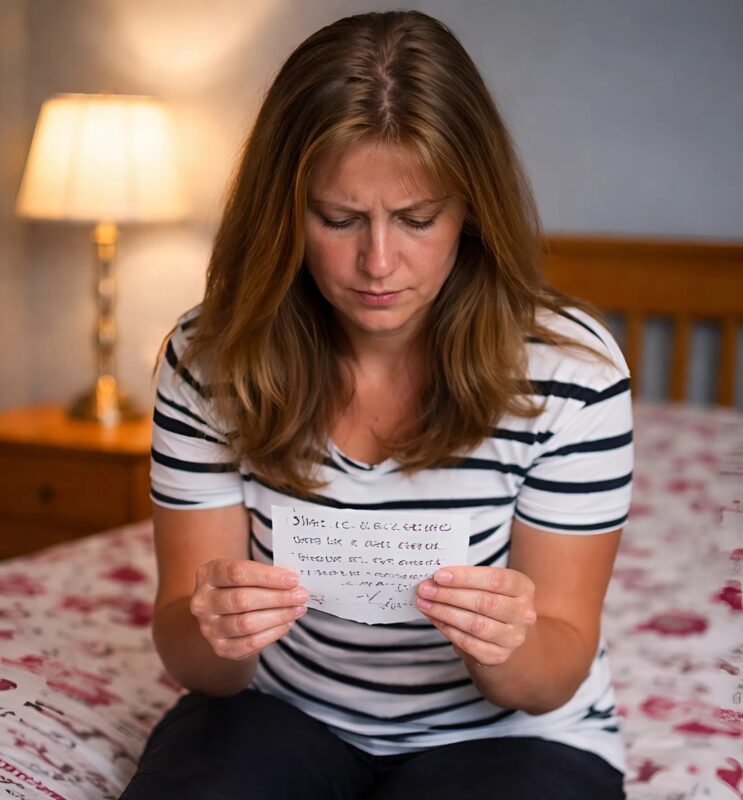
Finally, I knelt down beside the bed.
The space underneath was dark and covered in dust. At first, I saw nothing unusual. Then I noticed a small shoebox pushed toward the back, as if it had been hidden deliberately.
My hands shook as I pulled it out.
Inside were items I did not recognize at first. A worn belt. A wristwatch with a cracked face. A flash drive. None of these belonged to my daughter. They were unfamiliar, carefully placed together as though they had been stored with intention.
A cold sensation spread through me as I stared at them.
I took the flash drive and, after a long hesitation, connected it to the computer in her room. My hands were shaking so much that I almost dropped it.
A video file opened.
On the screen, my daughter appeared.
She was sitting in her room, the same room I was standing in, but the atmosphere in the video felt different—tense, frightened. Her eyes were red, and she kept glancing toward the door as if she expected someone to enter at any moment.
Her voice was soft and unsteady when she began to speak.
“Mom… if you are seeing this, I am not there anymore,” she said. “Please don’t think it was an accident. It wasn’t.”
I felt my breath catch in my throat.
She explained that she had been afraid, that something had been happening at home that she could not talk about openly. She spoke carefully, choosing her words as if she feared being overheard even in that moment. At one point, she lifted her sleeve slightly, revealing a mark on her arm.
She said it was important that I understood she had not simply fallen, as others might believe.
The video ended abruptly.
I sat frozen, unable to process what I had just seen. My mind struggled to connect the pieces. Memories began surfacing—small moments I had not fully understood at the time. My husband’s urgency to clear her room. His insistence that we move on quickly. His discomfort whenever I spoke about her too much.
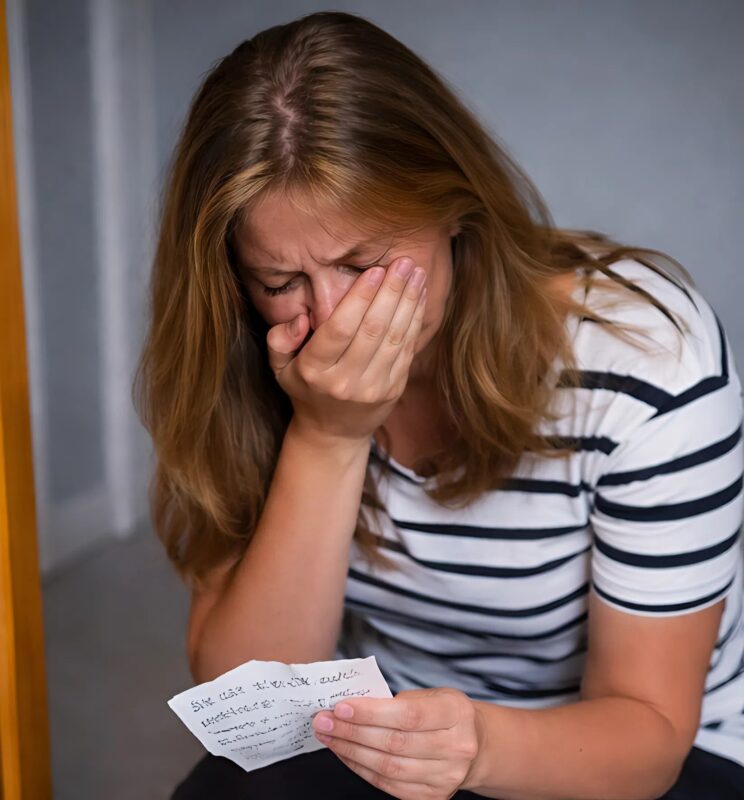
Everything began to feel different in retrospect, as though I was seeing fragments of a larger picture for the first time.
When I looked back into the shoebox, I noticed a second note at the bottom. It was shorter than the first.
“Don’t trust him. Go to the authorities. He is dangerous.”
My hands dropped to my lap. I could not think clearly. The room felt smaller, the air heavier. The life I thought I understood no longer made sense.
That night, I sat alone in her room for hours, holding onto the edge of her bed as if it were the only stable thing left in my world.
Eventually, I understood that I had reached a point where silence was no longer an option. Whatever truth my daughter had tried to leave behind could not remain buried.
I would have to face it, no matter what it meant for the rest of my life.

