
The 2026 White House Correspondents’ Association Dinner, held on April 25 at the Washington Hilton, was expected to follow its long-standing tradition as a formal and carefully organized event. Known for bringing together prominent figures from politics, media, and entertainment, the annual gathering is typically marked by speeches, networking, and public appearances from high-profile attendees.
This year’s event, however, unfolded in a way that shifted attention away from its usual structure. Reports of a security incident outside the ballroom led to an unexpected disruption, drawing focus not only to safety concerns but also to various moments from earlier in the evening that had already begun circulating online.
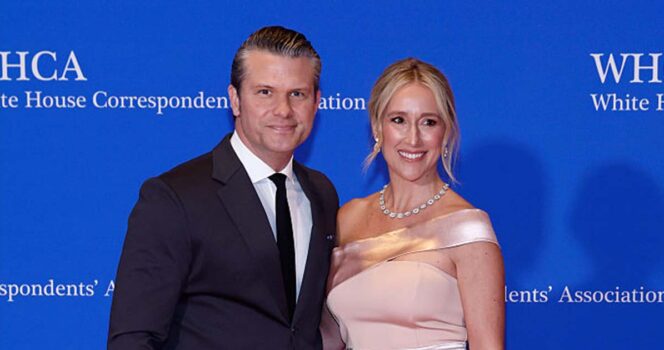
Among those in attendance were Donald Trump, JD Vance, and several members of the administration. The presence of these figures reinforced the event’s significance within the political and media landscape. Also attending were Pete Hegseth and his wife, Jennifer Rauchet, who arrived together and participated in the red carpet portion of the evening.
Before the reported disruption occurred, the atmosphere reflected the typical tone of the event. Guests posed for photographs, exchanged greetings, and took part in the formalities that have long defined the dinner. As with many high-profile gatherings, attention quickly extended beyond the event itself to the details of attendees’ appearances, including fashion choices.
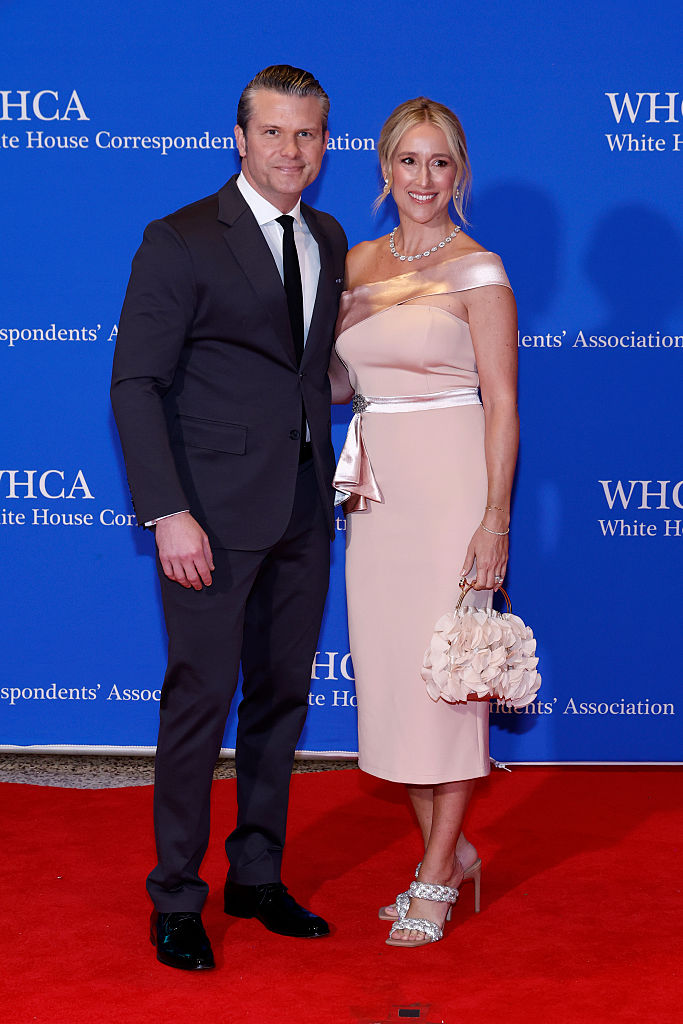
One aspect that drew particular attention online was Jennifer Rauchet’s outfit. Shortly after images from the event began circulating, a social media discussion emerged regarding the origin of the dress she wore that evening. An 18-year-old content creator, Ella Devi, shared a post suggesting that the dress resembled an item available on Temu.
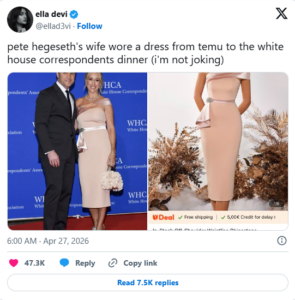
Her post included a side-by-side comparison between photographs of Rauchet at the event and a product image from the online retailer. The claim quickly gained visibility, prompting a wide range of responses from social media users.
As the discussion spread, reactions varied. Some individuals expressed criticism, suggesting that the dress may have originated from a lower-cost retail platform. Others questioned the accuracy of the claim or pointed out that similar designs can appear across multiple retailers, particularly in the context of fast fashion.
The conversation soon expanded beyond the specific item of clothing. Some participants in the discussion highlighted broader concerns about the fashion industry, including the practices of companies such as Shein and Temu, which have been frequently associated with reproducing popular design styles at lower price points.
At the same time, others challenged the criticism itself. They argued that choosing an affordable outfit should not necessarily be viewed negatively, especially in a context where expectations around high-cost fashion are often assumed. This perspective emphasized that clothing choices can reflect personal preference rather than adherence to perceived standards of luxury.
Ella Devi responded to some of the criticism directed at her claims. In her replies, she maintained her position regarding the dress and addressed comments about design originality and sourcing. Her responses contributed to the ongoing exchange, which continued to attract attention across different platforms.
The discussion also took on a political dimension. Some commentators connected the issue to broader themes related to domestic production and international manufacturing. In particular, questions were raised about whether public figures associated with certain political positions should prioritize clothing from specific sources.
This aspect of the conversation reflected how fashion can intersect with political identity and public perception. For some observers, clothing choices at high-profile events carry symbolic meaning, especially when those events involve individuals connected to government or policy discussions.
Ella Devi’s online presence played a role in shaping how her comments were received. Known for combining fashion-related content with political opinions, she has built a following that engages with both topics. Her previous posts and public statements have often blended commentary on style with perspectives on social and political issues.
As a result, reactions to her claims about the dress were influenced not only by the content of the post itself but also by her broader online identity. Some users supported her viewpoint, while others criticized what they perceived as inconsistency between her political stance and her focus on high-end fashion.
The debate also highlighted differing attitudes toward consumer behavior. Some participants emphasized the importance of affordability and accessibility in clothing, while others focused on brand identity, originality, and ethical considerations within the fashion industry.
Meanwhile, the reported security incident outside the event added another layer of attention to the evening. According to available information, an armed individual attempted to approach the venue, leading to a response from security personnel and a temporary disruption of the event. Authorities later began reviewing the situation and assessing relevant details.
While the incident raised concerns about safety, it also contributed to the overall visibility of the event in media coverage and online discussions. Moments from earlier in the evening, including red carpet appearances and social media commentary, continued to circulate alongside updates about the situation.
The combination of these factors—formal event proceedings, unexpected disruption, and online debate—resulted in a complex narrative surrounding the 2026 dinner. Rather than being remembered solely for its traditional elements, the event became associated with multiple overlapping discussions.
In particular, the attention given to Jennifer Rauchet’s dress illustrates how quickly a single detail can become a focal point in the digital age. Social media platforms allow for immediate sharing and commentary, often amplifying specific aspects of public appearances beyond their original context.
This dynamic reflects a broader shift in how public events are experienced and interpreted. While official proceedings and speeches remain central, parallel conversations online can shape public perception in real time.
It is also important to note that claims made on social media are not always independently verified. In cases such as this, discussions may be based on visual similarities or assumptions rather than confirmed information. As a result, interpretations can vary widely.
The broader conversation around fashion, identity, and public image continues to evolve, particularly in high-visibility settings like the White House Correspondents’ Association Dinner. Attendees are often subject to scrutiny not only for their roles or statements but also for their personal presentation.
In conclusion, the 2026 White House Correspondents’ Association Dinner became notable for a combination of factors, including its high-profile guest list, an unexpected security incident, and a widely discussed online debate about fashion. Jennifer Rauchet’s outfit, whether accurately identified or not, served as a starting point for broader discussions about consumer choices, industry practices, and the intersection of style and public perception.
As with many events in the current media environment, the conversation extended far beyond the venue itself, illustrating how digital platforms continue to shape the way public moments are observed and interpreted.

