
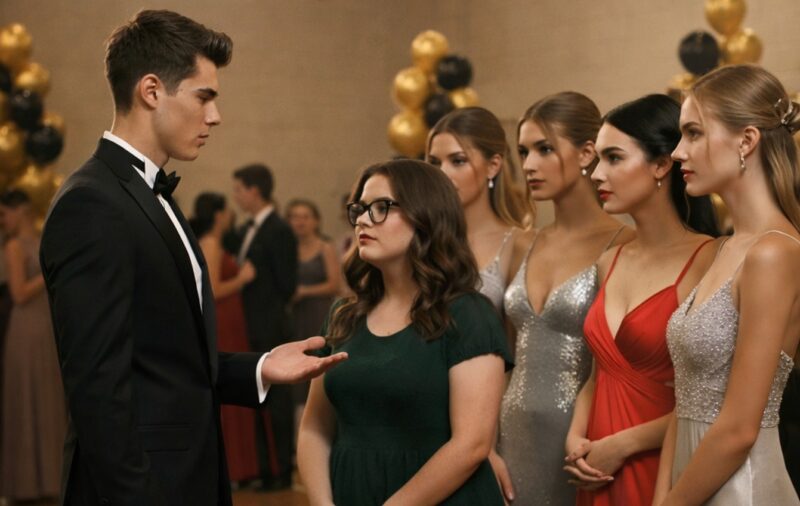
Prom night in the school gym unfolded much like any other end-of-year celebration. Warm string lights stretched across the ceiling, casting a soft glow over the room. Black and gold balloons decorated the walls, and a steady flow of music created a relaxed and festive atmosphere. Students gathered in small groups, laughing, taking photos, and enjoying one of the most anticipated evenings of their school years.
Among them stood Lena, positioned quietly near the refreshments table. She observed the scene from a distance, watching her classmates interact with ease. For her, events like this had never felt entirely comfortable. Over the years, she had often been the subject of unkind remarks and jokes related to her appearance. These experiences had shaped how she navigated social situations, especially in large gatherings where attention could quickly turn into scrutiny.
Despite those challenges, Lena chose to attend the prom. She understood that moments like this were part of a shared school experience, and she did not want to miss it entirely. She had carefully selected a simple dark green dress—modest, without elaborate decoration, but elegant in its own way. With help from her mother, she styled her hair and prepared for the evening with quiet determination.
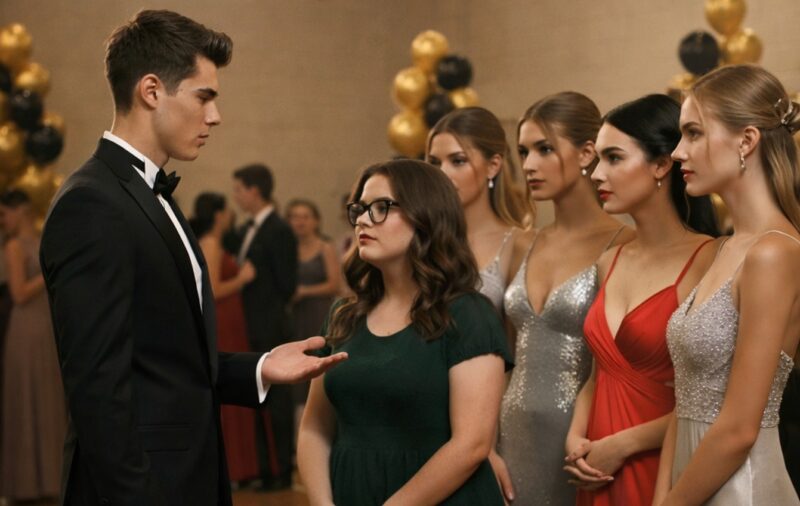
As the event progressed, the music shifted, and the host announced a slow dance. Couples began moving toward the center of the gym floor. The atmosphere softened as students paired off, some shyly, others with visible excitement. The space filled with gentle movement as the music guided them.
It was at that moment that something unexpected happened.
Artem, widely regarded by his classmates as one of the most confident and popular students, approached Lena. Dressed in a well-fitted black suit, he carried himself with ease. His presence alone drew attention, and when he stopped in front of Lena and extended his hand, the reaction around them was immediate.
“Would you like to dance?” he asked.
A subtle shift passed through the room. Conversations quieted, and nearby students began to watch more closely. Some exchanged glances, uncertain of his intention. Lena, however, understood the situation clearly. She recognized the tone, the expression, and the context behind the invitation. It was not unfamiliar territory for her.
Still, after a brief pause, she placed her hand in his.
“Alright,” she replied calmly.

Together, they walked to the center of the dance floor. The surrounding students formed a loose circle, curiosity growing. A few people lifted their phones, expecting something unusual or perhaps uncomfortable to unfold.
As the music began, Artem placed his hand lightly at Lena’s side. In a quiet voice, she spoke just loud enough for him to hear:
“You think I can’t dance.”
There was a brief moment of silence between them before the music carried forward.
Then, without hesitation, Lena removed her glasses and set them aside. She adjusted her posture, letting her hair fall naturally over her shoulders. When she began to move, the shift was immediate and unmistakable.
Her movements were controlled, fluid, and confident. Each step followed the rhythm with precision, and her posture reflected both training and self-assurance. What had started as a simple slow dance gradually evolved into something more expressive. She guided the movement naturally, transitioning from one step to another with ease.
At first, Artem appeared uncertain. The dynamic he may have expected did not materialize. Instead, he found himself adjusting to Lena’s pace, focusing on keeping in rhythm as she led the flow of the dance. His expression changed as he recognized the situation unfolding in front of him.
Around them, the atmosphere in the room shifted. The earlier whispers faded. Students who had expected humor or awkwardness instead watched quietly. Some lowered their phones. Others stepped closer, drawn in by the unexpected display.
Within moments, the gym fell into near silence. The attention of the entire room centered on the pair. Lena’s movements remained steady and composed, reflecting both skill and presence. Her confidence did not appear forced—it was natural, grounded in something she clearly understood well.
The dance continued for the duration of the song, maintaining a consistent rhythm and flow. What had begun as a moment of uncertainty became a demonstration of ability and self-possession.
When the music ended, there was a brief pause.

Then, gradually, applause began. It started with a few individuals and quickly spread throughout the room. The reaction was not exaggerated, but it was genuine. The performance had shifted perceptions in a way that required no explanation.
Lena gave a small, composed nod. She stepped away, retrieved her glasses from the nearby table, and put them back on. Without drawing further attention, she returned to her place near the edge of the room.
The moment did not rely on dramatic gestures or confrontation. Instead, it stood as a quiet but clear example of how assumptions can be challenged through action. What others may have expected to be a moment of embarrassment became an instance of confidence and skill.
For many in the room, the experience left a lasting impression—not because of spectacle, but because it revealed something they had not taken the time to see before.

