
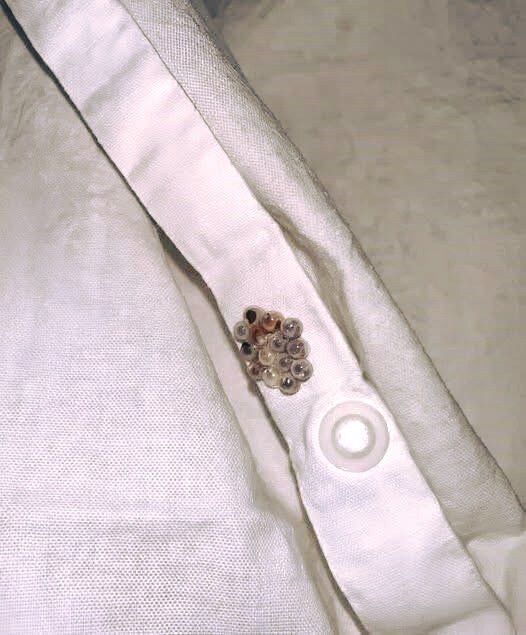
One morning, shortly after waking, I noticed something unusual scattered across my bed sheet. Small, round, pale objects were clustered loosely near where I had been sleeping. At first glance, they were difficult to identify. They didn’t immediately resemble anything familiar like dust, lint, or crumbs. Their presence stood out enough to interrupt the usual routine of starting the day, replacing it with a moment of uncertainty.
As I leaned closer to get a better look, a sense of unease began to build. The objects appeared too uniform in size and shape to be random debris. Each one looked smooth and rounded, and their grouping suggested some kind of pattern rather than coincidence. Because they were located directly on my bedding—a place associated with rest and personal comfort—the discovery felt more concerning than it might have in another part of the home.
I paused before touching anything, choosing instead to observe carefully. It seemed important to gather as much detail as possible without disturbing the objects. Their pale color and consistent shape raised the possibility that they might be related to insects, although I had no clear evidence to confirm that idea. At the same time, I was aware that appearances can be misleading, especially when encountering unfamiliar materials in unexpected places.
My thoughts turned to common household pests. Some insects are known to lay eggs in hidden or undisturbed areas, and although a bed is not typically one of those places, it could not be ruled out entirely. Still, I remained cautious about drawing conclusions too quickly. Misidentifying harmless particles as something more serious can lead to unnecessary stress, so I decided to approach the situation methodically.
To better understand what I might be dealing with, I began researching. I looked into various types of household insects and the appearance of their eggs, focusing on those that might occasionally enter indoor environments. Seasonal changes can drive certain bugs inside in search of warmth or shelter, so I considered whether that could be a factor.
During this process, I came across information about stink bugs. These insects are known for entering homes, particularly during cooler months, as they seek protected spaces. They are typically seen on walls, windows, or ceilings rather than on bedding, which made the connection uncertain. However, their eggs are often described as small, rounded, and arranged in clusters—details that seemed somewhat similar to what I had observed.
Further reading revealed that stink bugs usually lay their eggs outdoors, most often on the underside of plant leaves. This provides both protection and access to food once the eggs hatch. Finding such eggs indoors, especially on a bed, would be unusual. While it is possible for insects or their eggs to be carried inside accidentally—on clothing, pets, or other items—it is not considered common behavior for stink bugs to lay eggs in indoor sleeping areas.
Even with this information, I avoided making a definitive identification. Many everyday particles can resemble insect eggs under certain lighting conditions or from a distance. Without professional confirmation, it would not be responsible to assume the worst. Instead, I focused on practical steps that could address the situation regardless of the exact cause.
As a precaution, I removed all the bedding and washed it thoroughly using hot water and detergent. This step ensured that anything potentially harmful—whether biological or simply dirty—would be eliminated. I then vacuumed the mattress, bed frame, and surrounding floor area carefully, paying close attention to seams, corners, and any small crevices where particles might collect.
Cleaning provided some immediate reassurance, but I also wanted to understand how the objects might have appeared in the first place. I inspected the room more closely, checking windows, walls, and other possible entry points. Small gaps or openings can allow insects to enter a home, especially if there are no screens or if seals have worn down over time.
I also considered environmental factors. Light sources, temperature differences, and even nearby vegetation can attract insects toward a home. While there was no clear sign of an infestation, it seemed sensible to reduce any conditions that might encourage unwanted visitors. Keeping windows closed or properly screened, minimizing unnecessary lighting at night, and maintaining a clean indoor space can all help prevent insects from settling inside.
Over the following days, I monitored the situation carefully. I checked the bed and surrounding areas each morning to see if anything similar reappeared. Fortunately, there were no additional signs of the mysterious objects. This suggested that the incident may have been isolated rather than part of a larger issue.
The experience served as a reminder of how easily unfamiliar discoveries can trigger concern, especially in personal spaces like a bedroom. Because the bed is closely associated with safety and comfort, anything unusual found there can feel more alarming than it might elsewhere. However, responding with calm observation and practical action can make a significant difference.
It also highlighted the importance of not jumping to conclusions. While it is natural to assume the worst when something unfamiliar appears, careful research often reveals more ordinary explanations. In many cases, what initially seems unusual or even alarming can turn out to be harmless once properly understood.
Household insects, including stink bugs, are generally considered nuisances rather than serious threats. They do not pose direct harm to humans in most situations, although they can become bothersome if they appear in large numbers. Preventative measures—such as sealing entry points and maintaining cleanliness—are usually sufficient to keep them under control.
In the end, the situation was resolved through a combination of observation, research, and basic cleaning. Although the initial discovery was unsettling, it did not lead to any ongoing problems. Instead, it became a useful reminder of the value of awareness and routine maintenance in keeping a living space comfortable.
Small, unexpected details can sometimes disrupt our sense of normalcy, but they can also encourage us to be more attentive to our surroundings. By addressing concerns thoughtfully and without panic, it is possible to turn even an uncomfortable moment into a practical learning experience.

