
Hidden Object Found Under Bed Leaves New Homeowner Searching for Answers
Moving into a new home is often associated with excitement, anticipation, and the promise of a fresh start. New surroundings, new routines, and the opportunity to build a different chapter in life can make even the exhausting process of unpacking feel meaningful. For one homeowner, however, that sense of optimism quickly gave way to confusion and unease after an unexpected discovery on the very first day inside the house.
While cleaning the bedroom shortly after moving in, the homeowner began removing dust and debris left behind by previous occupants. It was a routine task—one that most people complete without much thought when settling into a new space. As they reached beneath the bed to clear the area, their hand brushed against something unusual. Instead of the typical forgotten items like papers or small belongings, they felt an object that was cold, solid, and clearly not meant to be there.
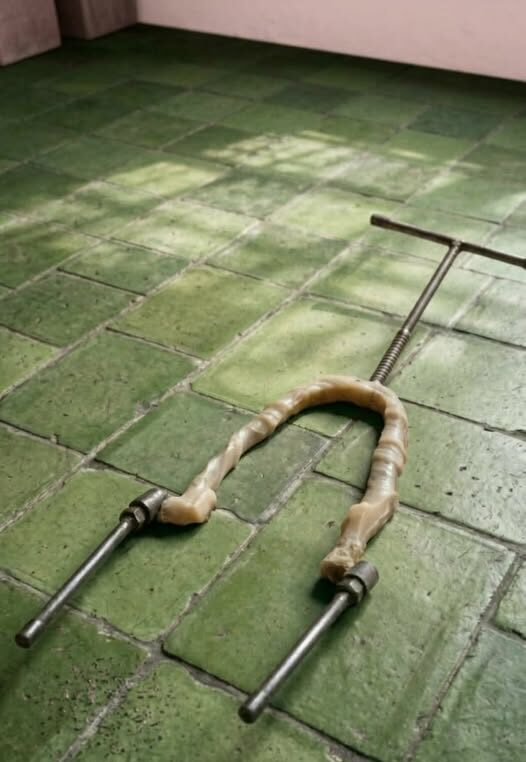
Carefully pulling it into view, the homeowner realized it was a heavy metallic device unlike anything commonly found in a residential setting. The object immediately raised questions. It did not resemble a household item, nor did it look like a typical tool used for simple repairs or maintenance. Its presence under the bed, hidden and covered in dust, made the discovery feel even more unsettling.
Upon closer inspection, the object revealed a distinct and deliberate design. It featured a T-shaped handle connected to a mechanism with two parallel rods. The structure appeared functional rather than decorative, suggesting it had a specific purpose. However, that purpose was not immediately clear. The design seemed mechanical and precise, as though it had been engineered for controlled use rather than casual handling.
The placement of the object added another layer of mystery. It had been pushed far back under the bed, in a position where it would likely remain undiscovered unless someone intentionally searched for it. Dust had accumulated around it, indicating that it had been left there for a considerable amount of time. This detail raised further questions about how long it had been in the house and why it had been left behind.
Driven by curiosity, the homeowner decided to examine how the device worked. They turned the handle slowly, observing the movement of the mechanism. As the handle rotated, the two rods began to separate in a steady and controlled manner. The motion required effort, suggesting that the device was designed to apply pressure or hold something in place rather than function as a simple tool.
The mechanical movement created a sense of unease. Without any context, the object’s purpose was difficult to interpret, and its design seemed unusual in a domestic environment. It did not resemble anything typically used in kitchens, bedrooms, or general household tasks. Instead, it appeared to serve a more specialized function—one that was not immediately obvious.
As often happens when people encounter unfamiliar objects, the homeowner’s imagination began to fill in the gaps. Several possibilities came to mind, some more concerning than others. Could it have been an antique restraint device? Was it a medical instrument from a past era? Or perhaps an industrial tool that had somehow ended up in a place where it did not belong?
The fact that the object had been hidden under a bed made each theory feel more dramatic. Objects that might seem ordinary in a workshop or professional setting can take on a completely different meaning when found in an unexpected location. In this case, the bedroom setting contributed significantly to the sense of mystery and discomfort.
Rather than leaving the question unanswered, the homeowner decided to research the object. They began comparing its design, structure, and moving parts with images of tools and devices found online. This process took time, as many tools shared certain similarities but did not match the object exactly. The combination of features—the expanding rods, the turning handle, and the overall construction—made it difficult to identify at first.
After several hours of searching and comparing, the homeowner eventually found an explanation. The object was identified as an older veterinary instrument known as a mouth gag, sometimes referred to as a speculum. These devices are used by veterinary professionals to gently and safely keep an animal’s mouth open during examinations or medical procedures.
With this information, the design of the object suddenly made sense. The controlled expansion of the rods, the sturdy construction, and the manual adjustment mechanism all aligned with the practical requirements of veterinary work. What had initially appeared unusual and potentially alarming was, in reality, a specialized tool designed for a specific professional purpose.
Despite the clarity provided by this discovery, the homeowner admitted that the uneasy feeling did not completely disappear. Even when an object’s function is understood, the context in which it is found can continue to influence how it is perceived. The fact that the device had been hidden under a bed remained difficult to ignore.
Questions about its history remained unanswered. Who had owned the device? Why had it been brought into the home? And perhaps most puzzling of all, why had it been left behind in such an unusual place instead of being stored properly or discarded?
These unanswered questions highlight a broader reality about homes and the objects they contain. When a property changes ownership, it often carries traces of previous lives within it. Items left behind in attics, closets, garages, or hidden spaces can offer small glimpses into the past, even if their full stories are never known.
In many cases, these discoveries are harmless—old books, tools, or personal belongings that were simply forgotten. However, when an unfamiliar object appears without context, it can create confusion before its purpose is understood. The human tendency to assign meaning to unknown items often leads to imaginative interpretations, especially when the setting feels unusual.
This experience also serves as a reminder that appearance alone can be misleading. Tools designed for specialized professions frequently look unfamiliar to those outside those fields. Without the proper context, even practical equipment can seem unusual or out of place.
Once identified, however, the same object can appear entirely different. What initially seemed mysterious or concerning becomes understandable, and its design can be appreciated for its intended function rather than misinterpreted based on appearance alone.
For the homeowner, the discovery transformed what should have been a routine move-in day into something far more memorable. Instead of focusing solely on unpacking and organizing, they spent hours investigating an unexpected object and trying to understand its purpose.
Although the mystery was eventually solved, the experience left a lasting impression. It served as a reminder that even in familiar environments like a home, unexpected discoveries can occur. These moments highlight how easily assumptions can form when context is missing and how important it is to seek accurate explanations before drawing conclusions.
In the end, the hidden device under the bed was not something dangerous or sinister, but rather a practical tool from a completely different setting. Still, its discovery added an unusual and unforgettable element to the homeowner’s first day in the new house.
Sometimes, the most memorable part of a new beginning is not what lies ahead, but what was left behind.

