
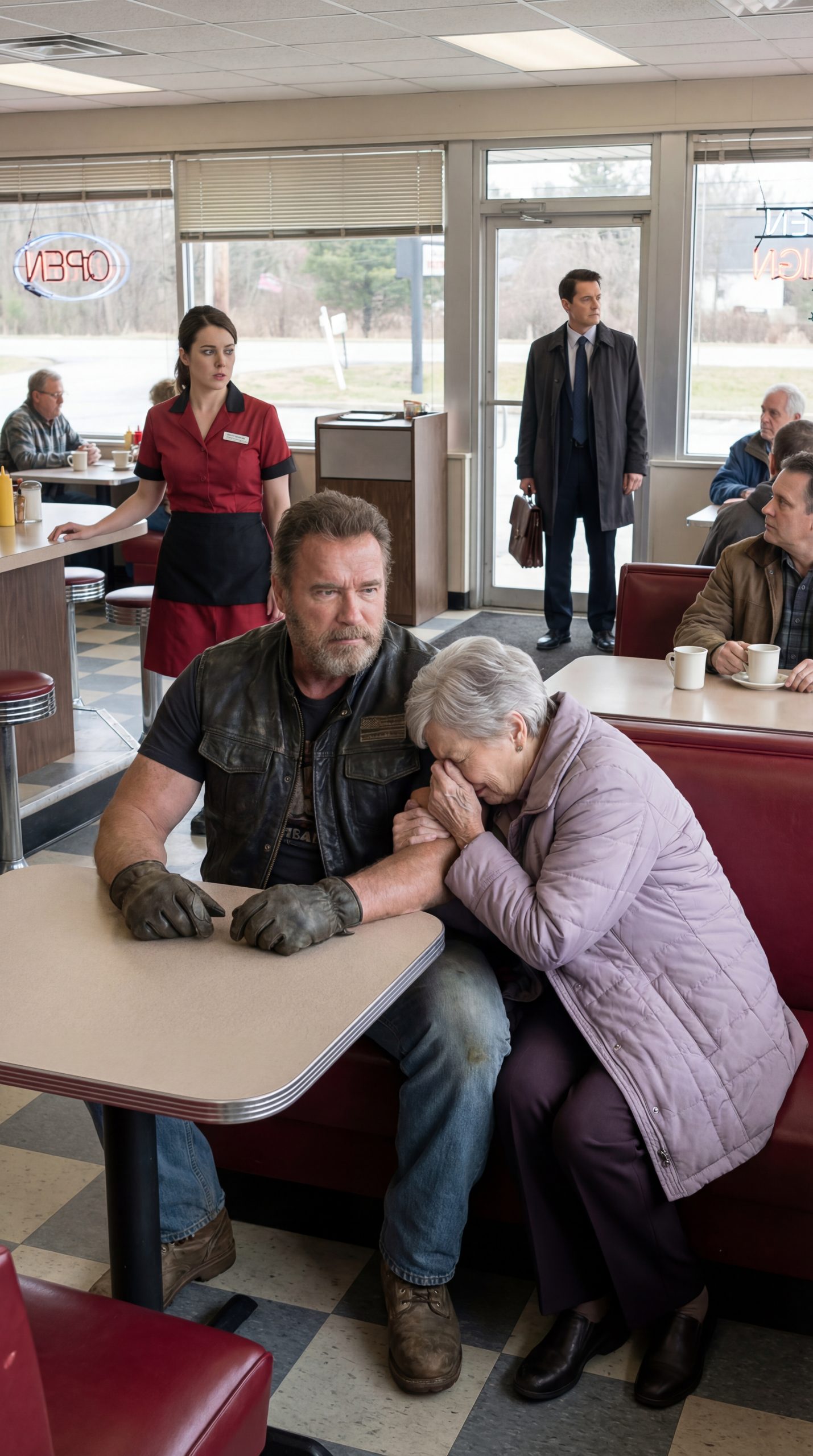
Storm at a Roadside Diner Turns Into a Night of Fear, Loyalty, and an Unlikely Bond
A Routine Evening Interrupted by the Storm
On a rain-soaked night in Carson Valley, a quiet roadside diner offered shelter to a handful of travelers and locals escaping the weather. Rain battered the windows, distorting the neon lights outside into blurred reflections, while inside, the atmosphere remained calm and predictable.
Customers lingered over meals, conversations stayed low, and the steady hum of the diner created a sense of normalcy. It was the kind of evening that typically passed without incident—until the moment everything changed.
A Woman’s Urgent Plea for Help
The shift began when an elderly woman entered the diner. Soaked from the storm and visibly shaken, she moved with urgency rather than hesitation. Instead of asking for general assistance, she approached a single individual seated nearby—a large, imposing man known locally as Colton Hayes, or “Griff.”
Leaning close, she spoke quietly but urgently:
“Please… pretend you’re my grandson.”
The request was unusual, but her tone suggested immediate danger rather than confusion.
A Split-Second Decision
Griff, a man accustomed to reading situations quickly, paused just long enough to assess her expression. Her fear appeared genuine, not exaggerated. Moments later, headlights swept across the diner windows, reinforcing the urgency of her request.
Without further hesitation, Griff responded.
“Grandma,” he said aloud, creating space beside him, “I told you not to be out in weather like this.”
The woman immediately understood and sat beside him, holding onto his arm as if the relationship were real.
The Arrival That Raised Suspicion
Shortly after, another man entered the diner. Dressed in a neat suit that contrasted sharply with the setting, he carried himself with confidence and control. His attention quickly fixed on the woman.
Approaching the booth, he addressed Griff calmly.
“I’m sorry,” he said, “but there’s been a misunderstanding. That woman is my mother.”
He presented what appeared to be supporting evidence on his phone, offering a composed explanation that might have convinced others under different circumstances.
However, Griff remained focused on more than just the surface details.
A Quiet Denial Changes the Situation
Leaning slightly toward the woman, Griff asked if she recognized the man.
Her response was immediate—a firm shake of the head.
“No… he’s lying.”
That brief exchange shifted the entire situation. Griff returned his attention to the man and responded calmly:
“Funny thing—my grandma says she doesn’t know you.”
Around them, the atmosphere in the diner began to change. Conversations faded as other patrons quietly took notice.
Tension Escalates in a Public Space
The man attempted to regain control, insisting the situation was private. However, the woman spoke again, this time more clearly:
“I’m not going with him.”
With that statement, any ambiguity disappeared. Griff stood, placing himself between her and the man.
“You heard her,” he said evenly.
The interaction grew more tense as additional individuals arrived outside, suggesting the situation extended beyond a simple misunderstanding.
A Shift in Momentum
As the situation escalated, more people began arriving in the parking lot. The growing presence outside the diner altered the balance of the encounter.
The once-controlled tone of the man in the suit began to weaken as it became clear he was no longer in a position of authority within the room.
At the same time, the woman found the confidence to speak more openly.
A Hidden Story Comes to Light
The woman, who later identified herself as Margaret, revealed that her situation involved more than a family dispute. She stated that her husband had uncovered sensitive information related to financial activity and hidden dealings.
According to her account, his findings placed them both at risk. He had intended to bring that information forward but was unable to do so.
Margaret expressed concern that the individuals pursuing her were attempting to silence her as well.
Witnesses and Accountability
As the situation unfolded, the presence of multiple witnesses in the diner played a crucial role. What might have otherwise remained a private confrontation became a public moment of accountability.
The individuals who had entered with confidence ultimately withdrew from the scene. Law enforcement later arrived, though the immediate tension had already begun to de-escalate.
Aftermath and Reflection
Following the incident, Margaret remained at the diner, visibly shaken but safe. A simple gesture—a warm drink placed in her hands—marked the shift from crisis to recovery.
Griff, who had initially been a stranger, sat across from her and introduced himself. In return, she shared her name.
What began as a brief act of assistance had evolved into something more meaningful.
A Decision That Extended Beyond the Moment
In the days that followed, the situation did not resolve immediately. Margaret’s account required further investigation, and the broader implications of her claims continued to unfold.
Griff, despite having no prior connection to the situation, chose to remain involved. His decision reflected not obligation, but a personal choice to provide support when it was needed.
Community, Support, and an Unlikely Bond
As attention turned toward uncovering the truth behind Margaret’s claims, support gradually formed around her. The isolation she had experienced began to give way to a network of individuals willing to stand by her.
Though not bound by family ties, those who supported her demonstrated a shared sense of responsibility and care.
A Lasting Message
The events at the Carson Valley diner serve as a reminder of how quickly ordinary situations can change—and how important individual actions can be in moments of uncertainty.
What began as a quiet evening interrupted by a storm became a story about awareness, courage, and the willingness to help others.
Margaret’s experience highlights the importance of listening, observing, and responding thoughtfully when something does not feel right.
Conclusion
That night did not stand out because of dramatic spectacle, but because of the choices made within it. A simple request for help was met with trust. A moment of tension was met with calm resistance. And a situation of uncertainty led to clarity through collective awareness.
In the end, the story reflects a broader truth: meaningful connections can form in unexpected places, and sometimes, the decision to stand by someone—even briefly—can make all the difference.

