
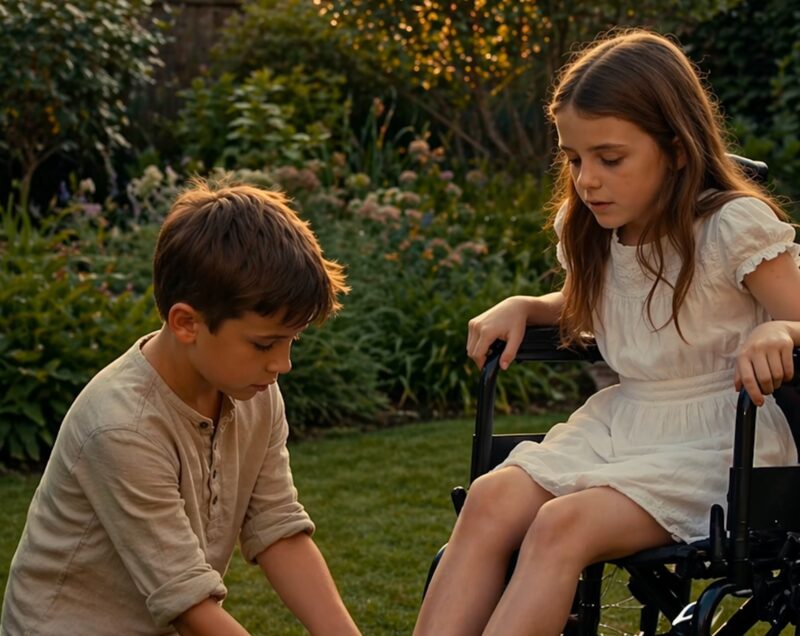
The young daughter of a wealthy businessman had not been able to walk for years. Despite access to the best medical care money could buy, no doctor had been able to help her. Specialists from around the world had examined her condition, reviewed her scans, and debated possible explanations, yet they all reached the same frustrating conclusion: there was no clear diagnosis, and no treatment that could restore her ability to walk.
Her condition remained a mystery. There was no sign of injury, no identifiable disease, and no obvious reason why her legs would not respond. Over time, hope began to fade—not just for the doctors, but for her family as well.
Her father refused to accept defeat. Determined to find a solution, he invested enormous resources into her care. He sent her to renowned clinics, consulted experts whose work was widely respected in the medical community, and pursued every possible avenue that offered even a small chance of recovery. Each time, the outcome was the same. Promising beginnings led to disappointing ends, and she always returned home in her wheelchair.
As the years passed, the emotional toll became increasingly difficult to bear. For the girl, life was defined by limitations. For her father, it was marked by a growing sense of helplessness. Despite his wealth and influence, he could not solve the one problem that mattered most.
One evening, the atmosphere at their home was unusually calm. The day had been warm, and the garden was quiet. Soft sunlight filtered through the trees, and a gentle breeze moved through the air. The girl sat outside in her wheelchair, looking out across the garden. For a brief moment, she seemed lost in thought, trying to escape the weight of her situation.
At that same time, the gardener’s son approached her. He was about her age, dressed simply, and carried himself with a quiet, somewhat uncertain demeanor. In his hands, he held an old metal basin filled with water.
He stopped in front of her and spoke in a calm voice.
“I know how to help you.”
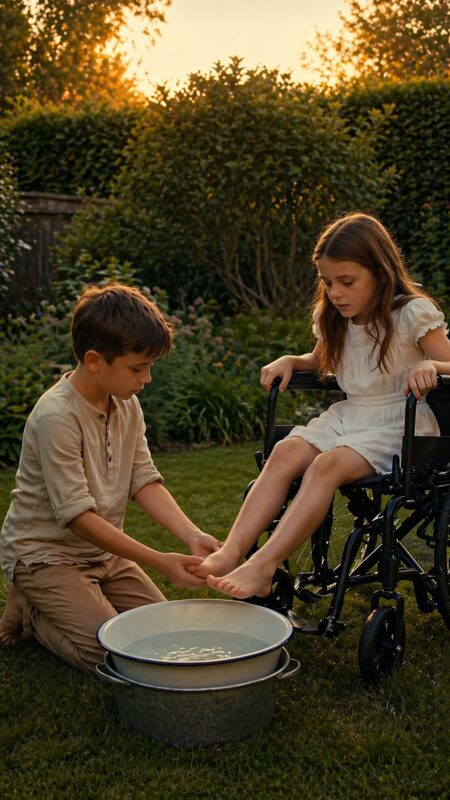
At first, she did not take his words seriously. Over the years, she had heard many promises—some from highly trained professionals, others from well-meaning individuals—but none had led to real change. Yet there was something different about the way he spoke. There was no hesitation, no sympathy in his tone, just a quiet confidence.
Without waiting for permission, he placed the basin on the ground and knelt in front of her. He carefully took hold of her legs, moving slowly and gently, as if he were aware of how sensitive the situation was. Then he lowered her legs into the warm water.
The reaction was immediate.
She tensed, her body stiffening as she drew in a sharp breath. Fear appeared in her eyes, as though she did not know what to expect.
“Don’t be afraid,” he said softly. “Just trust me.”
At that moment, something shifted.
From inside the house, the sound of a door opening broke the quiet. Her father had returned earlier than expected. As he stepped into the garden and saw what was happening, he froze for a brief second before reacting.
“What are you doing?” he shouted, quickly moving toward them.

The boy became visibly nervous but did not remove his hands. He seemed aware that he might have crossed a boundary, yet he remained in place, unsure whether to stop or continue.
The girl looked up at her father, and when she spoke, her voice sounded different—stronger, filled with something new.
“Dad… wait… I think I feel something.”
Her words stopped him in his tracks.
For the first time since her condition began, she was not speaking with uncertainty or cautious hope. There was genuine surprise in her voice. Her fingers moved slightly in the water—at first barely noticeable, then more clearly.
Her father slowly knelt beside her, focusing entirely on her legs. The garden fell completely silent. Even the smallest movement of the water could be heard as she continued to react.
“Say that again,” he said quietly.
She swallowed, her breathing quickening.
“I… I feel the warmth… and…” she paused briefly before continuing, “I can move them.”
Her father’s hands began to tremble.
For years, he had waited for any sign—no matter how small—that her condition might improve. Now, in front of him, something was happening that no doctor had been able to achieve.
He turned his attention to the boy, who was still sitting beside the basin with his head slightly lowered. The boy appeared calm, almost as if he had expected this outcome.
In that moment, the father realized something that challenged everything he believed.
He had relied on advanced technology, leading specialists, and extensive medical knowledge. He had searched across countries and institutions for answers. Yet the first real sign of change had come not from any of those sources, but from a simple, unexpected action performed by someone he had never considered.
The realization was difficult to process.
Then the boy spoke again, his voice steady.
“I’ve helped other children like this before,” he said. “But no one listens to me.”
The statement hung in the air.
The father looked at him, trying to understand what he meant. There were no immediate answers—only questions.
Who was this boy? How had he learned to do this? And if what he said was true, how many others might have been helped if someone had paid attention sooner?
The garden remained quiet as those thoughts settled in.
For the father, the moment marked a turning point—not only because of what had just happened to his daughter, but because it challenged his understanding of where solutions can come from.
For the girl, it was the first time in years that her body responded in a way that gave her genuine hope.
And for the boy, it seemed to confirm something he already believed—that sometimes, the answers people are searching for may come from the least expected places, if only someone is willing to listen.

