
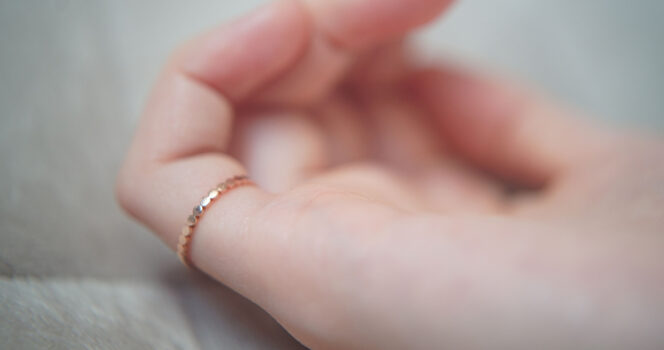
The idea that a ring always signals marriage is deeply ingrained—but that’s really only tied to one specific finger: the ring finger. Once you move beyond that, the meaning becomes much more fluid, and sometimes intentionally personal.
What a pinky ring can mean today
The newer trend you’re describing—wearing a ring on the pinky finger as a symbol of self-love—comes from a shift in how people use jewelry. Instead of signaling relationship status to others, it’s about making a quiet commitment to oneself.
Brands like Fred + Far helped popularize this idea, especially through their “self-love pinky ring.” Co-founder Melody Godfred framed it as a reminder to prioritize your own well-being, not just romantic relationships.
The symbolism is pretty deliberate:
- The pinky finger is rarely used for traditional rings, so it feels “unclaimed”
- Wearing a ring there flips the usual meaning of commitment—from someone else → to yourself
- It acts as a daily visual cue rather than a public announcement
It’s not as new as it sounds
Interestingly, pinky rings have had meanings long before this trend.
In the Victorian era, women sometimes wore rings on their left pinky finger to signal that they were single and not seeking marriage—a kind of early, subtle social messaging system.
Pinky rings have also been used in other contexts:
- Family crests or signet rings
- Professional identity (especially among certain groups)
- Pure fashion, with no deeper meaning at all
So the modern “self-love” version is really a reinterpretation, not a completely new invention.

How much meaning should you read into it?
Here’s the reality: you can’t assume a single meaning anymore.
A pinky ring might mean:
- A self-love commitment
- A fashion choice
- A sentimental or family piece
- Or nothing symbolic at all
That’s very different from a wedding ring, which still carries a widely understood message.
Why this trend resonates
The popularity of this idea reflects a broader cultural shift:
- Less emphasis on defining identity through relationship status
- More focus on self-worth, independence, and personal rituals
- A desire for symbols that feel internal rather than performative
Whether someone buys into the symbolism or not, the appeal is simple: it gives people a small, tangible way to express something that’s usually abstract.
So if you see someone wearing a pinky ring, it might be meaningful—or it might just match their outfit. The difference now is that the meaning, if there is one, belongs entirely to the person wearing it.

