
Property Dispute Over Trees Leads to Road Closure and Eventual Resolution
The story of a property dispute in a quiet residential area illustrates how personal loss, legal rights, and community dynamics can intersect in unexpected ways. What began as the removal of several trees evolved into a broader conflict involving access, responsibility, and ultimately, resolution through dialogue and accountability.
A Personal Loss With Deep Meaning
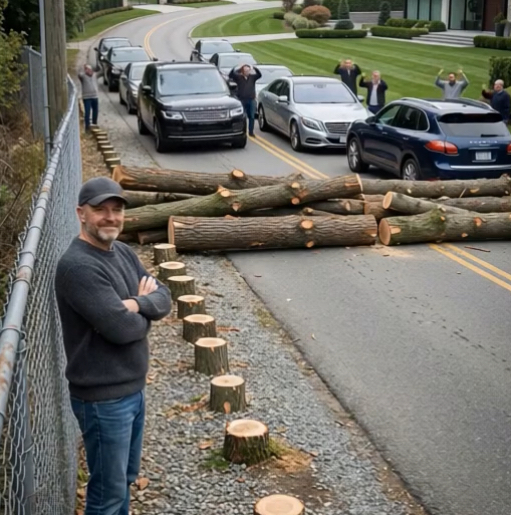
Eli stood on his land, trying to process the sudden and irreversible change before him. Where a row of mature sycamore trees once stood, only rough stumps remained. These were not just ordinary trees. They had been part of his family’s land for years, planted and cared for over time, representing both natural beauty and emotional significance.
The loss was more than visual. Each tree carried memories connected to his father and the years they had spent together maintaining the property. Their presence had become part of the land’s identity. Seeing them removed without his knowledge or permission created a strong sense of frustration and disbelief.
For Eli, the issue extended beyond landscaping concerns. It was about respect for property boundaries and the violation of something deeply personal. The absence of the trees left both a physical and emotional gap that could not easily be ignored.
A Decision Driven by Principle
Standing nearby, Mara observed quietly. She understood the situation’s seriousness, even if she had not shared the same history with the land. When Eli finally spoke, his voice was steady but firm.
“We need to do something,” he said.
Mara asked what he had in mind, sensing the weight behind his words. Eli paused briefly, then responded with clarity: “We’re closing the road.”
The road in question was a small but important access point used by residents of Cedar Ridge Estates. Although frequently used by the community, it was located entirely on Eli’s property. This fact became central to his decision.
Acting Within Legal Boundaries
Before taking action, Eli made sure to understand his legal rights. He consulted with a lawyer, explaining the situation in detail and confirming that he had the authority to restrict access to the road if necessary.
Once he received confirmation, he proceeded carefully. The next morning, temporary fencing was installed, along with clear signage indicating that the road was closed. The process was deliberate and lawful, ensuring that his response would not create additional legal complications.
As the final barrier was secured, Eli experienced a sense of control returning. While it did not undo the damage to his property, it marked a step toward addressing the situation in a meaningful way.
Immediate Impact on the Community
The road closure quickly became a topic of discussion within the neighborhood. Residents who had relied on the route for daily travel were surprised to find it inaccessible. What had once been a routine part of their day suddenly required adjustment.
Shortly after, Eli received a call from Richard, the president of the homeowners association. His tone reflected concern and urgency.
“What’s going on with the road?” Richard asked.
Eli responded calmly, explaining that there had been a misunderstanding regarding property boundaries. He made it clear that until the issue of the removed trees was addressed, the road would remain closed.
Richard expressed frustration, emphasizing the inconvenience to residents. However, Eli stood firm, pointing out that his property rights had been disregarded. For him, the closure was not an act of retaliation, but a measure to ensure the matter was taken seriously.
Divided Reactions Among Residents
As days passed, opinions within the community began to diverge. Some residents sympathized with Eli, recognizing the importance of property ownership and the emotional impact of losing something meaningful.
Others, however, focused on the inconvenience caused by the road closure. They felt caught in a situation that disrupted their routines without directly involving them.
These differing perspectives highlighted the complexity of the dispute. It was not simply a matter of right or wrong, but a situation where individual interests and community needs intersected.
Despite the varying opinions, Eli remained focused on his objective. He was not seeking conflict but resolution.
Transition to a Legal Process
Eventually, the situation moved into a more formal phase. Lawyers representing both sides became involved, and discussions began to take place within a structured legal framework.
Eli presented clear evidence of property ownership and the unauthorized removal of the trees. The homeowners association, in turn, sought a resolution that would address the issue while restoring normal access for residents.
The process required time and patience. Documents were reviewed, proposals were exchanged, and both sides worked toward a solution that would be acceptable to all parties involved.
Throughout this period, Eli maintained a consistent position. He emphasized accountability and respect, ensuring that the core issue remained central to the discussion.
Maintaining Resolve Under Pressure
As the dispute continued, pressure increased. Residents continued to express concerns about the road closure, and the inconvenience became more noticeable over time.
Despite this, Eli did not change his stance. For him, the situation represented more than a temporary inconvenience. It was about protecting his rights and honoring the legacy associated with his property.
The trees had symbolized years of care and personal history. Allowing their removal to go unaddressed would have meant overlooking something of lasting importance.
His decision to remain firm ensured that the matter would not be dismissed or minimized.
Reaching a Resolution
After several weeks of discussion, the homeowners association acknowledged the situation and moved toward a resolution. They agreed to provide financial compensation for the loss of the trees, recognizing their value and the mistake that had occurred.
In addition to compensation, a formal apology was issued. This acknowledgment played a crucial role in resolving the conflict, as it addressed not only the material loss but also the issue of respect.
With these steps in place, both sides reached an agreement. The dispute, which had created tension throughout the community, began to settle.
Restoration and Moving Forward
Following the agreement, Eli removed the barriers and reopened the road. Residents were able to resume their normal routines, and the immediate disruption came to an end.
For Eli, reopening the road was not a concession, but a step forward after ensuring that his concerns had been properly addressed.
He then turned his attention to the future. In place of the removed trees, he planted new sycamore saplings. While they would take years to grow, they represented renewal and the continuation of something meaningful.
These new trees could not replace what had been lost, but they offered a way to rebuild.
A Lasting Impact
Over time, the situation left a lasting impression on both Eli and the community. It served as a reminder of the importance of respecting property boundaries and addressing conflicts through communication and accountability.
For the residents of Cedar Ridge Estates, it highlighted how individual actions can affect a broader community. For Eli, it reaffirmed the importance of standing firm when something meaningful is at stake.
As the new trees begin to grow, they stand as quiet symbols of resilience and renewal. They represent not only the passage of time but also the lessons learned from a situation that brought both challenge and resolution.
In the end, the story reflects how conflicts, when approached thoughtfully and responsibly, can lead to outcomes that restore balance while reinforcing the values of respect, patience, and understanding.

